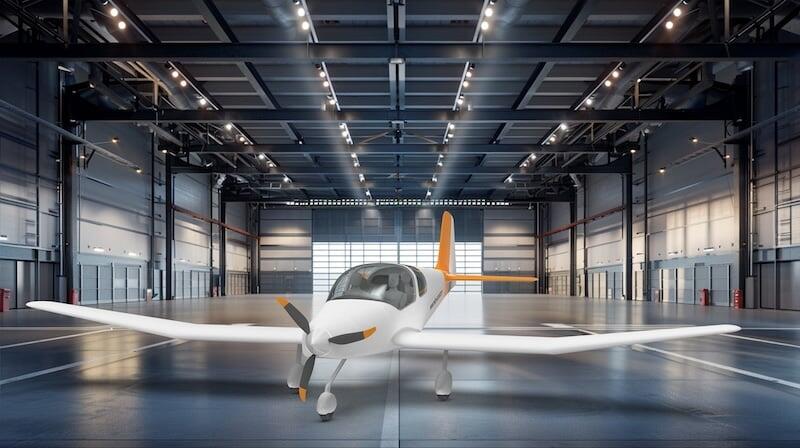
Milan's electric MA-2 has folding wingtips to reduce span for parking.
Swiss startup Milan Aircraft has closed a seed funding round to finance building a prototype of the powertrain for its planned four-seat MA-2, an electric training aircraft designed for 2 hr. of usable flight endurance.
With a target total flight endurance of 2.5 hr., including 30-min. reserves, the MA-2 is designed to cover 100% of a typical private pilot training program, Milan says. The only electric trainer so far certified, Pipistrel's Velis Electro, has a 50-min. flight endurance plus reserves, sufficient to perform airport pattern training but not cross-country flying.
Bern-based Milan was founded in 2024 and has flown a one-seventh-scale model of its aircraft. The seed funding round included investors from the Sictic and Aare Ventures angel networks as well as private individuals. As the next step, Milan plans a Series A fundraising round to begin construction of a full-scale flying prototype of the MA-2 in 2027.
Milan says it accepted one fundamental reality in designing an electric aircraft: that batteries will remain heavy for many years to come. Rather than modify an existing aircraft, the startup says it started by defining the battery system needed for a practical training mission, then designed the aircraft around it from a clean sheet.
Targeting European Union Aviation Safety Agency CS-23 certification, the resulting MA-2 has a maximum takeoff weight of 1,750 kg (3,860 lb.). The aircraft has an air-cooled, direct-drive electric motor producing 243 kW (330 hp.) takeoff power and a 170-kWh battery system that can be recharged in under one hour using a 150-kW charger.
A takeoff noise level of 59 dB(A) allows operation from noise-sensitive airports, Milan says. Available with fixed or retractable gear, the MA-2 has a long wing to minimize cruise drag and energy consumption, but foldable wingtips allow span to be reduced from 12 m (39.4 ft.) to less than 7 m for parking.
High power and a flap system Milan describes as “distinctive” enables takeoff with a ground roll of less than 350 m. Maximum cruise speed exceeds 170 kt but is set at 100 kt for training operations. Range exceeds 400 km (250 mi.).

Related Content