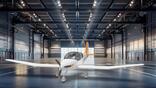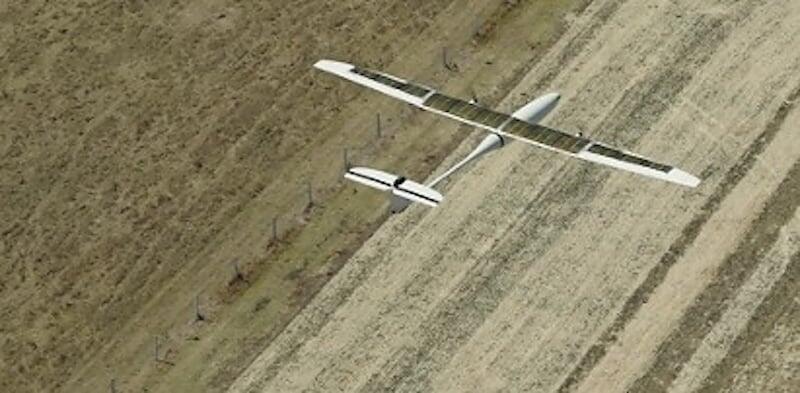
The Pegasus long-endurance drone in flight over Queensland, Australia, powered by lithium-sulfur batteries and perovskite solar arrays.
An Australian-developed, long-endurance uncrewed aircraft has demonstrated a flight time of almost 2 hr., powered by energy-dense lithium-sulfur (Li-S) batteries and ultra-lightweight perovskite solar arrays.
The Pegasus drone was developed jointly by airframe manufacturer V-TOL Aerospace, battery developer Li-S Energy and solar technology company Halocell Energy under the Australian government’s Emerging Aviation Technology Partnership (EATP) program.
The two-motor, 5-m-wingspan (16.4-ft.) drone completed several flights in Queensland, culminating in an endurance flight of almost 2 hr., covering more than 75 km (46 mi.) while powered by a single Li-S battery pack and landing with energy to spare.
Featuring a metallic lithium anode and sulfur cathode, the Li-S pouch cell has an energy density of 347 Wh/kg compared with 192 Wh/kg for a conventional lithium-polymer cell widely used in uncrewed air vehicles (UAVs), Li-S Energy says.
“On a same-cell weight basis, the Li-S Energy cells delivered 80% more range and flight time than would have been achieved by an equivalent high-performance professional lithium-polymer UAV battery pack,” the company says.
Fitted with the two Li-S battery packs it is designed to accommodate, and with projected improvements in the performance of the perovskite solar cells, the Pegasus is expected to be capable of flights of 5-8 hr. and up to 250 km for long-endurance missions.
The endurance test flight marked the culmination of the project, which was supported by AU$1.35 million ($940,000) in government funding under the EATP program. The flight data will now be analyzed to help evaluate the Pegasus platform’s commercial potential.

Related Content