Vandenberg Supports Reentry Vehicle Test, Fourth SDA Data Relay Launch
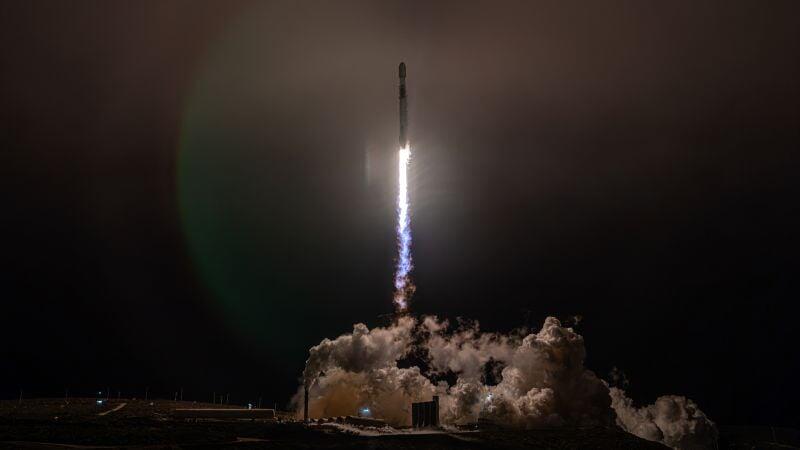
A SpaceX Falcon 9 rocket launches Oct. 10 from Vandenberg, SFB, California, carrying 21 satellites for the Space Development Agency to low Earth orbit.
The U.S. Western Range supported the Pentagon’s most recent test of an unarmed ICBM reentry vehicle on Oct. 9, before launching the latest batch of data relay satellites for the Space Development Agency just around 24 hr. later.
A Northrop Grumman Minotaur rocket lifted off at approximately 3:43 a.m. EDT from Space Launch Complex-8 at Vandenberg SFB, California, carrying an unarmed Mk21A reentry vehicle, the U.S. Air Force confirmed after the launch.
The reentry vehicle, in development by Lockheed Martin, will be integrated on the service’s forthcoming LGM-35A Sentinel ICBM after reaching full operational capability. The recent launch marked the second prototype test for the Mk21A in two years, with the previous launch occurring on June 17, 2024.
As the Air Force’s Sentinel program ramps up, Vandenberg’s launch management unit, Space Launch Delta 30, is preparing the base to support the program with such prototype launches and other activities, officials have said.
Less than one day later, SpaceX launched the SDA’s fourth plane of Tranche 1 Transport Layer satellites on Oct. 10 at 3:39 a.m. EDT on a Falcon 9 rocket from SLC-4E, bringing the first plane of spacecraft built by Northrop Grumman to orbit.
It marked the fourth of nine launches SpaceX is currently contracted to support for the SDA’s Tranche 1 constellation under the Space Force’s National Security Space Launch Phase 2 program. Following stage separation, the Falcon 9’s first stage booster landed on Landing Zone 4 at Vandenberg SFB, per SpaceX.
The SDA mission was originally slated to launch Oct. 5, but the Falcon 9’s automated systems halted the initial countdown just before liftoff. The launch was then pushed off two more times as SpaceX conducted extra safety checks on the vehicle and worked with the Space Force to deconflict with other mission deployments, including the Minotaur launch.
The new plane of 21 satellites brings the SDA’s current tally of space vehicles on orbit to 84, the agency said Oct. 10.
The new satellites will help to build out the SDA’s Transport Layer, envisioned as an orbital mesh network providing 24/7 global data relay to support space-based missile warning and tracking, tactical user connectivity and beyond-line-of-sight targeting. New satellites built by L3Harris Technologies as part of the missile defense-centric Tracking Layer are expected to launch by early next year. The SDA expects the full Tranche 1 network will provide initial warfighting capability beginning in 2027, per the release.
Related Content