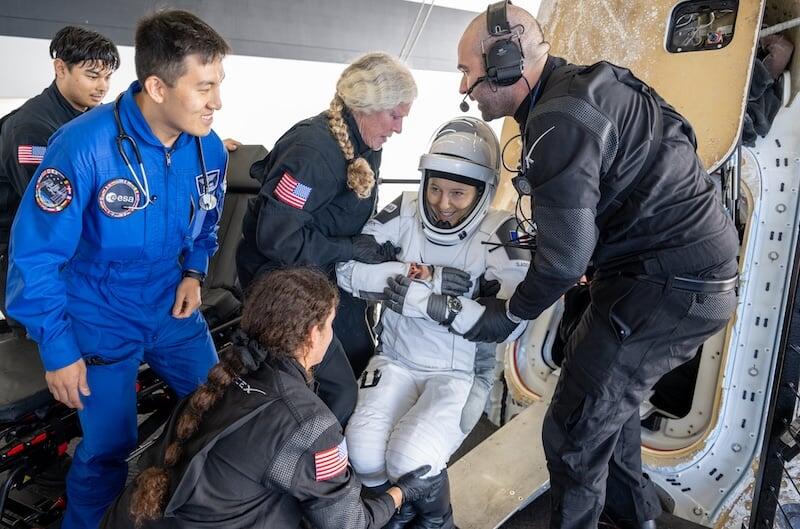
European Space Agency astronaut Sophie Adenot is helped out of the SpaceX Crew Dragon Freedom spacecraft after she and her crewmates splashed down in the Pacific Ocean on Oct. 8 to complete a seven-month mission aboard the International Space Station.
CAPE CANAVERAL—In a 648-page solicitation, NASA outlined an ambitious scope of work for commercial entities interested in developing, building and flying a new station in low Earth orbit (LEO) to host astronauts and experiments after the International Space Station (ISS) program ends.
NASA on Oct. 9 posted the final request for proposals for Phase 2 of the Commercial LEO Destination (CLD) contract, kicking off a keenly watched competition among what could be four or more potential bidders.
“We have spent a lot of time listening to industry and working through what it will take to make this transition successful,” NASA Administrator Jared Isaacman said in a press release. “The opportunity is significant, but the economics ultimately have to work. We want to see credible plans, strong technical execution and companies prepared to invest in destinations that can serve NASA while developing additional customers and markets of their own.”
NASA intends to award multiple firm-fixed-price, indefinite-delivery/indefinite-quantity contracts to support development, certification and flight services for LEO research and technology development programs. The work would support “two or more contractors through early development, followed by a competitive task order for final design, test and evaluation, as well as certification and services from one or more contractors,” the agency said.
The solicitation sidesteps a potential issue with crew flights and cargo resupply runs to the commercial outposts by allowing bidders to shift responsibility to NASA to procure the rides.
Currently, SpaceX’s Crew Dragon system is the only U.S. spacecraft certified to fly astronauts. SpaceX operates a fleet of five Crew Dragon capsules, which launch aboard Falcon 9 rockets. The company has been developing a successor space transport—the Starship-Super Heavy system—and has not publicly set a target timeframe to retire the Dragon, nor what role, if any, Starship could have to support the CLD program.
NASA has contracts for Crew Dragon flights through 2028. The ISS, which has been continuously staffed by rotating crews of astronauts and cosmonauts for nearly 26 years, is targeted to be decommissioned in 2030.
Meanwhile, NASA is stepping up work with Boeing to mature the troubled CST-100 Starliner spacecraft as an alternative to Crew Dragon. A fourth flight test of the Starliner is expected in three to four months.
Proposals for the CLD Phase 2 contract are due Dec. 8, with awards expected in spring 2027. Prospective bidders include Axiom Space, Blue Origin and Voyager Technologies, all of which have some funding from NASA for initial CLD programs, and startup Vast, which holds an unfunded Space Act Agreement with NASA for work on its Haven space station program.

Related Content