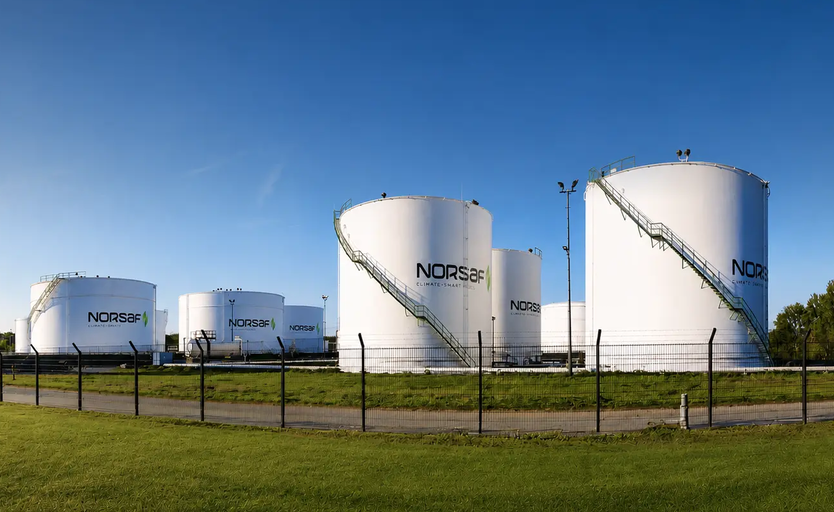
Latvia's NorSAF will partner with UK-based Nova Pangaea Technologies to build an ethanol plant supplying the Baltic region's largest sustainable aviation fuel facility.
The project will use locally sourced wood waste to make ethanol using Nova Pangaea's proprietary technology.
When at full capacity, the planned production plant, at Latvia's Liepāja Special Economic Zone, will produce 100,000 metric tons of sustainable aviation fuel (SAF) per year. Production is expected to begin in 2031.
The NorSAF/Pangaea partnership aims to address Europe's challenge of meeting increasing demand for SAF while developing more resilient and locally sourced feedstock supply chains.
Under EU regulations, aviation fuel suppliers are required to increase the share of SAF at EU airports, rising from 2% in 2025 to 6% in 2030 and to 20% by 2035.
Currently, Europe relies heavily on waste oils and fats from which to produce SAF. This requires importing large quantities of feedstocks such as used cooking oil. Around 85% of Europe's SAF feedstocks come from overseas, with China accounting for 61%.
Agricultural and forestry residues provide regional alternatives, particularly in countries like Latvia, where these bioresources are abundant.
Nova Pangaea's Refnova technology converts waste biomass, such as woody and agricultural residues, into ethanol and biochar, a co-product that permanently captures carbon and makes the whole process carbon negative, according to the companies. The resulting ethanol can then be converted into SAF through the alcohol-to-jet pathway as part of NorSAF's planned SAF production.
“Europe cannot strengthen its energy security simply by reducing fossil-fuel imports,” NorSAF founder Janis Kisiels said. “We also need to build the industrial capacity to produce the clean fuels that will replace them.
“By tapping into Europe's own abundant waste resources, we can build a resilient, domestic supply chain from the ground up. Our partnership with Nova Pangaea is a crucial milestone in developing that strategic capability right here in Latvia, ensuring our future SAF production is sustainable, secure, and locally anchored,” Kisiels said.
“This strategic collaboration will ensure we have carbon-negative ethanol to feed NorSAF's SAF project, using locally sourced biomass waste,” Nova Pangaea Chief Commercial Officer Jonathan Wood said. “This is a blueprint for the type of partnerships we need to scale SAF production in Europe and all regions of the world, enhancing energy security, building a new domestic industry that generates jobs and economic growth while reducing fossil-fuel emissions.
“According to the International Air Transport Association (IATA), there is sufficient waste biomass available in Europe to produce enough SAF to meet Europe's ambitious SAF targets for 2050,” he said.
The NorSAF/Nova Pangaea partnership builds on the latter's work with British Airways and LanzaJet on Project Speedbird, a UK government-supported initiative to develop SAF from non-food agricultural and woody biomass. That collaboration has a Latvian connection, as Nova Pangaea's technology is based on research conducted at the Latvian State Institute of Wood Chemistry, before further development and demonstration work in the UK.
The proposed Latvian feedstock project complements this development by exploring the potential to source part of the raw material required for future SAF production from the forestry and agricultural waste available in the region.

Related Content