
Space Industry Analysis

May 21, 2012
It has been almost 50 years since Mariner 2 became the first space probe from Earth to return scientific data from another planet. The swarms of ever-more-sophisticated robotic spacecraft that followed have changed our view of the planets around our Sun in ways that seem incredible today. On Aug. 27, 1962, when Mariner 2 lifted off for Venus, many scientists believed Earth's sunward neighbor was a steamy jungle planet beneath its clouds. Data from the two-channel microwave radiometer on Mariner 2 quickly disabused everyone of that notion. Passing within 22,000 mi.

May 21, 2012
SpaceX will get an early opportunity to show what it can do to help scientists and engineers use the International Space Station by flying a powerful thruster testbed up in the unpressurized section of its Dragon cargo capsule.

May 21, 2012
The International Space Station has a crew of six again, following launch and docking of Russia's Soyuz TMA-04M capsule with two cosmonauts and a NASA astronaut on board. The May 17 linkup restored the station to six-person operations for the first time since April 27, when a crew of three U.S. and Russian fliers descended to Earth after 5.5 months in orbit. Cosmonauts Gennady Padalka and Sergei Revin and NASA's Joseph Acaba (seen in this photo taken in the Russian space agency control room) lifted off from the Baikonur Cosmodrome in Kazakhstan on May 15.

May 21, 2012
Scientific and industrial research investments have yet to pay off.
May 14, 2012
Three Apollo commanders put their weight behind legislation that would force NASA to move quickly to choose a single commercial crew vehicle to elicit public support. Neil Armstrong, Eugene Cernan and James Lovell, commanders of Apollo 11, 17 and 13, respectively, told Rep. Frank Wolf (R-Va.), chairman of the House appropriations subcommittee that funds the space agency, that they endorse his panel's approach to commercial crew vehicle development that passed the House last week.

May 14, 2012
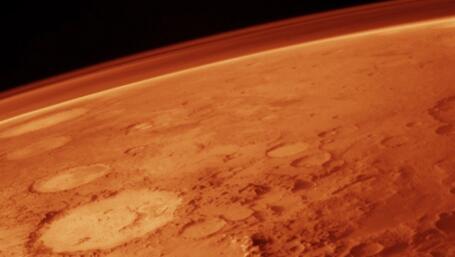
The big nuclear-powered Mars rover is NASA's last chance to drive scientific instruments around on the Martian surface in this decade.
Mar 25, 2020
The European Space Agency is reducing on-site personnel at its mission control center in Darmstadt, Germany, and switching some science missions into standby mode.

Mar 25, 2020
The European Space Agency is planning a public webcast on March 26 for astronauts to share their experience and techniques for living in confined spaces.
Mar 25, 2020
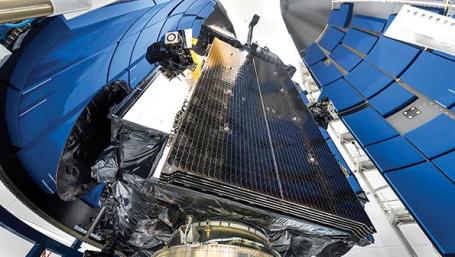
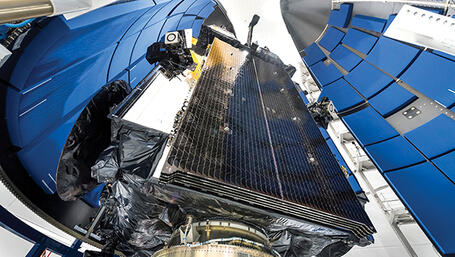
The U.S. Space Force is looking forward to “voice recognizable” communications with the expected completion of the six-satellite Advanced Extremely High Frequency constellation.
Mar 25, 2020
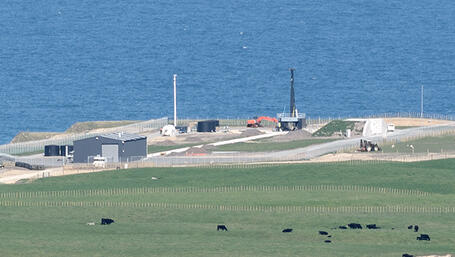
Preparations for Rocket Lab’s next launch, a rideshare mission of small research satellites, have been suspended because of newly announced New Zealand government restrictions designed to limit the spread of the COVID-19 disease.
Mar 25, 2020
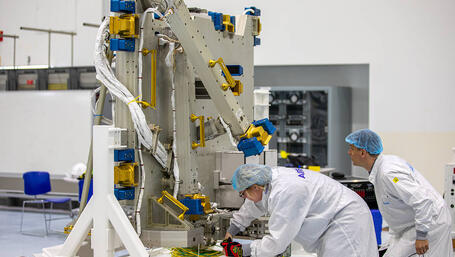
Using the International Space Station’s robot arm, ground controllers removed Bartolomeo, the recently launched European commercial external experiment platform, from the SpaceX Dragon cargo capsule late March 24.

Mar 25, 2020
A SpaceX Dragon 2 test article was destroyed on March 24 during what was to be one of the final tests of the craft’s parachute system ahead of a…
Mar 24, 2020
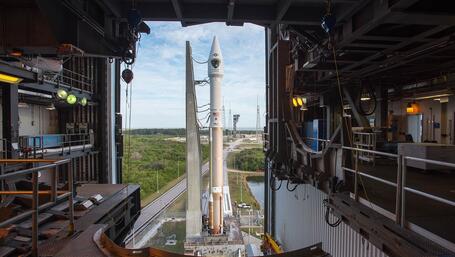
The four-way competition for a pair of National Security Space Launch (NSSL) contracts remains on track for award this year despite work restrictions stemming from concerns about the spread of the coronavirus, the U.S. Air Force said on March 24.
Mar 24, 2020
In the midst of shutdowns and work restrictions to prevent the spread of COVID-19, United Launch Alliance and the U.S. Air Force 45th Space Wing at Cape Canaveral AFS here are preparing for the March 26 launch of an Atlas V rocket carrying the sixth and final member of the Air Force’s Advanced Extremely High Frequency satellite network.