
U.S. Spacewalkers Complete Space Station Docking Port Antenna Installations, Cable Extensions
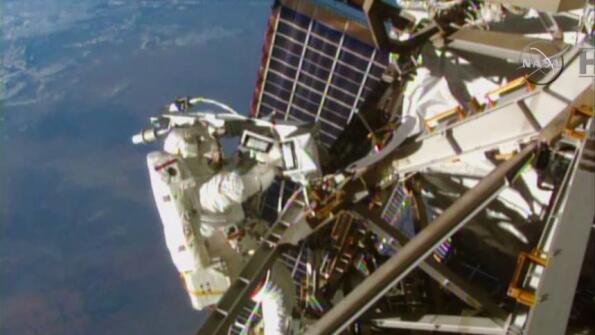
U.S. spacewalkers Terry Virts and Barry “Butch” Wilmore marched through their third spacewalk in eight days on Sunday, racing ahead of schedule to complete all tasks assigned to them to prepare the International Space Station for two new docking ports to accommodate future U.S. commercial crew transportation spacecraft.
As soon as they departed the ISS airlock, Virts and Wilmore parted company, quickly moving to the mid-points of the port and starboard segments of the station's 360-foot-long solar power truss to install booms and equip each with two antennas.
They reunited outside the U.S. Destiny lab module, where they attached four cable leads and integrated them to existing GPS and Ku communications systems. Next, they moved port then starboard extending and securing more than 400 feet of new cabling between Destiny and the newly installed antenna booms.
The new cabling, antennas and laser reflectors on the booms will furnish guidance and navigation data to the automated Boeing CST-100 and SpaceX Dragon spacecraft and their crews during the rendezvous and docking phases of flight. NASA intends to inaugurate commercial crew launches by late 2017. The introduction will end reliance on Russia's Soyuz capsules for the transportation of astronauts to and from the station during the post-shuttle era.
After Sunday’s 5 ½ hour excursion, which concluded at 12:38 p.m., EST, Virts reported a small volume of water inside the face plate of his helmet -- just as he did at the conclusion of the Feb. 25 spacewalk.
"Not a big deal," Virts assured his colleagues and NASA's Mission Control from the airlock, as he prepared to remove his helmet.
The golf ball sized blobs were attributed to the vagaries of his suit's cooling system sublimator within the pressurized environment of the airlock.
"There is no issue to the crew's safety," said NASA spacewalk commentator Dan Huot from Mission Control.

NASA astronaut Terry Virts, left, and Barry "Butch" Wilmore move along the port segment of the space station's solar power system truss. NASA photo
Mission managers and flight control teams also closely monitored the life support systems of the two suits for signs of corrosion buildup in the fan pump separators that circulate air and cooling system water. Corrosion was blamed for causing previous fan pump separators to bind. Further difficulties were not reported.
The third spacewalk represented an early milestone in efforts by NASA to establish commercial docking ports on the forward end and space facing circumference of the station's Harmony module prior to Wilmore's scheduled return to Earth late March 11. Wilmore, the station's current commander, and cosmonauts Alexander Samokutyaev and Elena Serova will descend in their Soyuz TMA-14M capsule to end 167 days in orbit. Wilmore was the more experienced of the two spacewalkers, as the series of three excursions got under way.
During spacewalks on Feb. 21 and 25, Virts and Wilmore extended and fastened new communications, data and heater cabling to Pressurized Mating Adaptor-2 on the forward end of Harmony, the docking port used by the shuttle orbiters until their retirement in 2011. They extended cables to the space facing circumference, where PMA-3 will be relocated from the station's Tranquility module using Canada's robot arm as a construction crane.
Both PMAs will be fitted with new International Docking Assemblies developed by NASA and a Boeing-led contractor team. The IDAs will permit the actual docking of the Boeing and SpaceX capsules. The first of the IDAs is ready for launching in June aboard a SpaceX Dragon commercial re-supply mission. NASA spacewalkers will install IDA-1 on PMA-2 in July.
Four more U. S. spacewalks are planned this year to support the work which will include the installation of IDA-2 on PMA-3.
In the meantime, astronauts will be working inside the ISS on reconfigurations to accommodate the dockings of the new U.S. commercial crew vehicles as well as using the robot arm to relocate the four-year-old Leonardo Permanent Multi-purpose Module to improve clearances for the station's commercial cargo berthing ports as well as the commercial crew parking spots.
On Sunday, Virts took on the lead role for the spacewalk, a responsibility previously shouldered by Wilmore. Their experience from the previous two excursions was evident as they got an early start and moved 90 minutes ahead of schedule with their tasks.
"You guys are doing great," Sunita Williams, who helped to guide their activities from NASA's Mission Control, radioed the spacewalkers at one point.
"That's what we want to hear," said Virts.