
U.S., Russian, European Crew Reaches International Space Station
Russia's Soyuz TMA-13M spacecraft successfully docked with the International Space Station's Russian segment late Wednesday, restoring the orbiting science laboratory to six person operations for several months of demanding activities that include the anticipated resumption of U.S. maintenance spacewalks that were suspended last July when water leaked into a NASA space suit helmet.

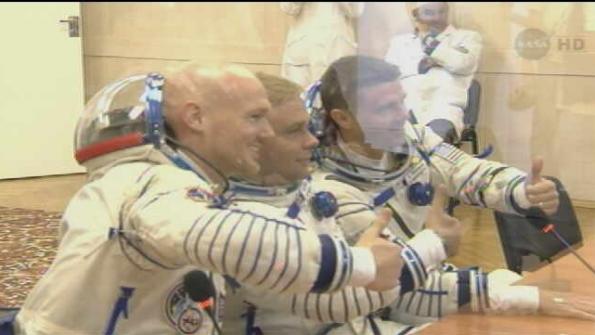
Cosmonaut Maxim Suraev, left, and NASA's Reid Wiseman await launch in Soyuz spacecraft. NASA TV
The docking at 9:44 p.m., EDT, delivered Maxim Suraev, a veteran Russian cosmonaut, and two first time space travelers, NASA's Reid Wiseman, a U.S. Navy test pilot, and the European Space Agency's Alexander Gerst, a German geophysicist.
They were greeted by ISS commander Steve Swanson, of NASA, and cosmonauts, Alexander Skvortsov and Oleg Artemyev. The three men had staffed the station on their own since the scheduled May 13 departure of three Japanese, American and Russian crew members.
"You've got help on the way," NASA's Mission Control informed Swanson, the Expedition 40 commander, moments after the Soyuz rocket lifted off from the Baikonur Cosmodrome in Kazakhstan at 3:57 p.m., EDT, or Thursday at 1:57 a.m., local time.

U.S., Russian, European crew departs Baikonur Cosmodrome on six hour, four orbit rendezvous timeline. NASA TV
The TMA-13M's express four orbit, six hour transit unfolded without the difficulties that turned the March 25 Soyuz launching of Swanson, Skvortsov and Armey into a two day transit when the capsule failed to reach the proper attitude for the third of four post-launch rendezvous maneuvers. The difficulty was attributed to an overly restrictive attitude limit in the Soyuz light controls that was subsequently relaxed.
The station's newcomers left behind terrestrial tensions over Russian interference in Ukraine and an exchange of economic sanctions imposed by Washington and Moscow in response. So far, cooperation aboard the U.S.-led 15 nation ISS appears unaffected.
"The team has really come together and is really strong -- even at this time when it's a little shaky overall politically," noted William Gerstenmaier, NASA's associate administrator for human exploration and operations, who was at Baikonur for the launching. "There is a tremendous spirit of how we can achieve the greater purpose of what we are doing in space. We can be a model for how real teams come together despite challenging times."
Swanson offered as much in an assessment from the ISS earlier this week.
"We talk about it, more in the sense of what the politics are doing," he said. "It doesn't affect our working relationship. We are still good friends."
The re-fortified station crew faces a challenging four months. Five spacewalks loom, including a flurry of three choreographed by NASA to resume external maintenance activities suspended last July when water leaked in the helmet of the U.S. spacesuit worn by Italian astronaut Luca Parmitano.
An investigation traced the leak to a clogged fan pump separator in the water cooling system of the suit's personal life support system backpack. Filters that shed the silica particles responsible for the clog have been replaced as have the pump separators. Engineers are assessing samples of cooling system water returned to Earth by the latest SpaceX Dragon mission earlier this month to wrap up the probe and clear the way for three U.S. spacewalks in August.
Swanson, Wiseman and Gerst will share the NASA spacewalk assignments, which are likely to address cooling and power system issues as well as the first steps in moving the three-year-old U.S. Permanent Multi-purpose Module to establish docking ports for U. S. commercial crew transport vehicles expected to begin arriving in late 2017.
Skvortsov and Atemyev are to install communications antennas, extend a payload boom and deploy and retrieve external experiments during Russian spacewalks planned for June and August.
Up to five multinational re-supply missions are planned. They include the European Space Agency's fifth and final Automated Transfer Vehicle in late July and August. Meanwhile, the ISS astronauts are responsible for participating in or overseeing more than 150 science experiments and engineering demonstrations.