
SpaceX's Fourth Dragon Mission Ends with Pacific Ocean Splashdown
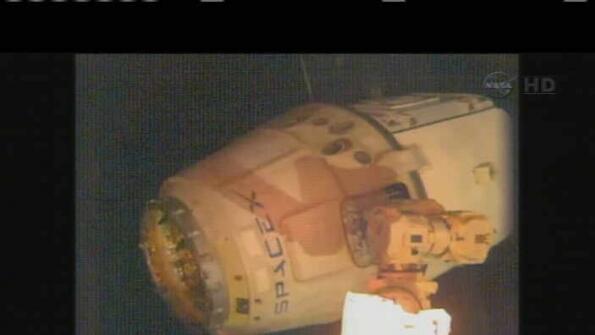
SpaceX's fourth resupply mission to the International Space Station ended successfully on Saturday with a splashdown of the Dragon capsule in the Pacific Ocean 265 miles west of Baja, Calif., an operation that clears a parking spot aboard the six person orbiting science lab for Orbital Sciences' third Cygnus cargo delivery mission next week.
Dragon and nearly 3,300 pounds of research samples, experiment gear and other hardware splashed down under parachute at 3:38 p.m., EDT, SpaceX confirmed. A SpaceX recovery vessel with divers was positioned for the descent, retrieval and a trip to port in Long Beach, Calif., for initial unloading.
Dragon departed the ISS at 9:57 a.m., following its release from the grip of the station's Canadian robot arm, which was controlled by U. S. astronauts Reid Wiseman and Barry "Butch" Wilmore. Three propulsive maneuvers of the capsule nudged it safely away from the ISS and on a course to a position 93 miles from the station for a 2:43 p.m., 10 minute de orbit burn.
Saturday's departure opened a berthing port on the station's U. S. segment Harmony module for Orbital's Cygnus. The "Orb-3" capsule, packed with just over 5,000 pounds of new research equipment and station hardware, is scheduled to lift off atop a two stage Antares rocket from the Mid-Atlantic Regional Spaceport on Virginia's eastern shore on Monday at 6:44 p.m., EDT.
The launching will start Cygnus, which has been named for NASA Mercury astronaut and commercial space pioneer Deke Slayton, toward a Nov. 2 rendezvous and berthing with the ISS. Wiseman and Wilmore will again be positioned in the orbital outpost's Cupola observation deck at the controls of the 58-foot-long Canadian robot arm for the capture.
SpaceX and Orbital are carrying out ISS resupply missions under respective $1.6 billion, 12 flight and $1.9 billion, eight flight NASA resupply contracts awarded in late 2008.
The fourth Dragon mission began with a Sept. 21 lift off atop a Falcon 9 rocket from Cape Canaveral Air Force Station, Fla. The rendezvous and berthing followed two days later.
Dragon's cargo included RapidScat, a new external ISS radar sensor developed to monitor wind speeds and direction at the ocean surface, a prototype 3-D printer as well as 20 mice, a collection of fruit flies and plants, all subjects in research projects intended to document metabolic and genetic changes in living organisms in response to weightlessness. Half of the mice were among the near 2,100 pounds of science equipment scheduled to return to Earth aboard Dragon.
Orbital's six day Cygnus journey to the ISS will permit the Russians to carry out resupply activities of their own.
Russia's Progress 56, which conducted an automated docking with the station's Russian segment on July 23, is scheduled to depart the ISS early Monday. The replacement Progress 57, carrying nearly 5,000 pounds of propellant, food and other supplies, is scheduled to lift off from the Baikonur Cosmodrome in Kazakhstan early Wednesday and dock six hours later.