
Russian Soyuz Overcomes Solar Array Problem to Deliver Three to ISS
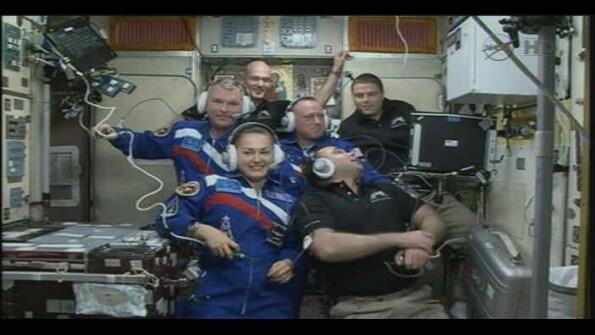
Russia’s Soyuz TMA-14M spacecraft carried out a successful automated docking with the International Space Station late Thursday, delivering three new U.S. and Russian crew members, including the first female cosmonaut assigned to live and work aboard the orbiting science laboratory.
The six hour, four orbit launch to docking transit unfolded despite the failure of the port solar array on the capsule to deploy properly after the lift off. However, 38 minutes after the linkup, the port array deployed normally, and NASA reported it seemed to be functioning properly.
"This anamoly will soon be forgotten," predicted Bill Gerstenmaier, NASA's associate administrator for human exploration and operations. Gerstenmaier was among the agency dignitaries at the Soyuz launch complex. A preliminary analysis indicated that capsule could have carried out a single solar array re-entry with the three astronauts, if necessary, he said.
The crew transport carrying NASA astronaut Barry “Butch” Wilmore, Alexander Samokutyaev and Elena Serova docked with the Russian segment Poisk module at 10:11 p.m., EDT, several minutes ahead of schedule.
“Capture confirmed,” radioed the Soyuz crew, “We’re latched.”

Soyuz TMA-14M commander Alexander Samokytyaev, left, and co-pilot Elena Serova await lift off with NASA's Barry "Butch" Wilmore , not visible in this view, from the Baikonur Cosmodrome in Kazakystan. NASA TV

NASA's Barry "Butch" Wilmore, left, strolls to the launch pad at the Baikonur Cosmodrome in Kazakhstan with crewmates, Alexander Samokutyaev, center, and Elena Serova. NASA TV.
The newcomers were greeted by ISS Expedition 41 commander Max Suraev (of Russia), NASA’s Reid Wiseman and Alexander Gerst (of the European Space Agency). The linkup restored the ISS to six crew operations for the first time since Sept. 10, when three U.S. and Russian fliers returned to Earth after more than five months in orbit.
The Soyuz TMA-14M lifted off from the Baikonur Cosmodrome in Kazakhstan at 4:25 p.m., EDT, or Friday at 2:25 a.m., local time. The three stage Soyuz launch vehicle and capsule climbed through misty overcast skies to reach orbit. The starboard power generating solar panel and communications antennas deployed as scheduled.
The port solar array failure proved a non-issue because of the capsule’s battery power and the short trip. Four scheduled rendezvous maneuvers required to carry out the expedited launch to docking transit that would otherwise take two days were conducted as planned.
“We are monitoring the batteries and they seem to be fine,” Russia’s Mission Control told Samokutyaev, the Soyuz commander, during post-launch troubleshooting.
The new crew has trained to live and work aboard the ISS for five to six months.
Wilmore, 51, a U. S. Navy captain, is in line to succeed Suraev as ISS commander in November. He piloted an 11-day NASA shuttle space ISS assembly and re-supply mission in 2009.
Samokutyaev, 44, a retired Russian air force colonel, logged 164 days aboard the ISS in 2011 as a flight engineer.
Serova, a 38-year-old flight test engineer, is the first Russian woman to reach orbit since cosmonaut Elena Kondakova, who flew aboard a nine-day NASA shuttle mission in May 1997.
Serova, who served as Samokutyaev's backup pilot aboard the Soyuz, has striven to keep the focus of the mission on her responsibilities as a flight engineer rather than her gender.
The six member crew will participate in or supervise more than 150 experiments and technology demonstrations.
In October, NASA plans to supervise a pair of maintenance spacewalks, the first choreographed by the agency since cooling system water leaked into the helmet of the U.S. space suit worn by European Space Agency astronaut Luca Parmitano in July 2013.
All but emergency U.S. spacewalks were placed on hold after the incident while NASA traced the source of the leak to a blocked cooling system fan pump separator within the protective garment and engineered repairs. Plans to resume the excursions in August were delayed again when a new issue arose with the fuses in the spacesuit batteries.
Two sets of new batteries are now aboard the station, one pair carried by the new Soyuz transport and the other delivered by the commercial SpaceX Dragon resupply mission that berthed to the U. S. segment early Tuesday.