
Rosetta's comet lander suffers setback
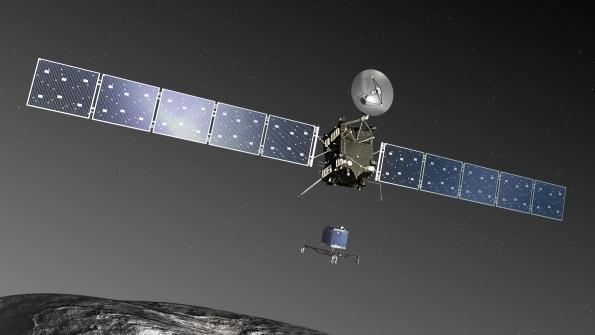
Europe's Rosetta mission has suffered a setback that will complicate an attempt to land a small probe on the surface of Comet 67P/Churyumov–Gerasimenko Nov. 12: During checks on the lander’s health overnight, mission managers discovered its active descent system, which provides a cold-gas thrust to avoid rebound at the moment of touchdown, cannot be activated.
As the probe reaches the comet's surface, landing gear will absorb the force of the touchdown while ice screws in each of its three feet and two harpoons will lock the Philae probe to the dusty terrian. At the same time, a thruster atop the lander was supposed to push it down, counteracting the impulse of the harpoons in the opposite direction.
However, "the cold gas thruster on top of the lander does not appear to be working so we will have to rely fully on the harpoons at touchdown,” says Stephan Ulamec, Philae lander manager at the German Aerospace Center DLR. “We’ll need some luck not to land on a boulder or a steep slope.”
Paolo Ferri, ESA's head of mission operations, said “There were various problems with the preparation activities overnight but we have decided to go. Rosetta is lined up for separation.”
Philae's separation from the Rosetta orbiter is slated for 3:35 a.m. eastern this morning, but radio signals from the transmitter onboard Rosetta will need nearly half an hour to reach Earth and be transferred to the Rosetta Mission Control Center at ESA’s Space Operations Centre in Darmstadt, Germany.
The descent to the surface of the comet will take around seven hours, with confirmation of successful touchdown expected in a one-hour window before noon eastern.