
The Rise of Orion
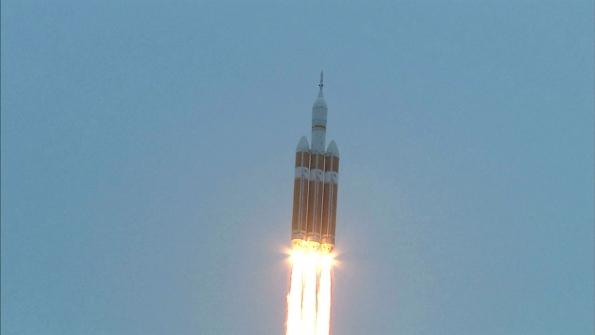
Following a successful dawn lift off and a successful first lap around the Earth, the unpiloted NASA/Lockheed Martin Exploration Flight Test-1 Orion capsule soared to 3,600 miles above the Earth on Friday, setting up a blistering high velocity atmospheric re-entry and parachute assisted splashdown in the Pacific Ocean.
The second stage of the United Launch Alliance Delta IV rocket that lifted Orion to orbit from Cape Canaveral Air Force Station, Fla., at 7:05 a.m. EST, roared to life again at 9 a.m., for 4 minutes, 40 seconds to achieve the desired 3,604 mile high peak altitude for the mission at 10:11 a.m.
The boost and its high altitude outcome set up the final chapters of the 4 ½ hour test flight, a 20,000 mile per hour re-entry through the Earth’s atmosphere, generating temperatures of 4,000 degrees around Orion’s heat shield. A joint NASA, Lockheed Martin recovery team awaited an 11:30 a.m., EST, splashdown in the Pacific Ocean about 600 miles southwest of San Diego aboard the USS Anchorage and the USNS Salvor.
The Orion re-entry approximates the conditions experienced by nine NASA Apollo lunar missions between 1968 and 1972.
“It’s been well rehearsed,” said NASA astronaut Suni Williams, who was aboard the Anchorage for the recovery. “There’s been a lot of preparation, a lot of fine tuning.”
Thrusters to guide Orion during the return were activated successfully at 9:47 a.m., EST, Mission Control reported. The set includes a dozen redundant hydrazine fueled thrusters positioned on eight pods.
The Delta IV upper stage is to separate at 10:28 a.m., EST. The capsule is to re-encounter the Earth’s atmosphere at 11:16 a.m., EST. Splashdown is predicted for 23.6 degrees, North Latitude, 116.46 degrees, West Longitude.
As the Orion/Delta IV second stage reached apogee, it pierced the Earth’s Van Allen Radiation Belt for the first of two times on the flight. The initial 15 minute exposure subjected the spacecraft to radiation levels that stressed the function of the capsule’s avionics, much as they would be with a crew of astronauts headed for deep space. There was no adverse impact on the Orion’s systems, according to NASA’s Mission Control.
The second Van Allen Belt high radiation exposure, which was to last about 35 minutes, is to unfold at 10:35 a.m., EST.
The early phases of the flight pleased mission managers as key components of the rocket, including the inert Launch Abort System, fell away as planned. All of EFT-1’s 17 separation events were unfolding as planned and being monitored closely by black box recorders aboard the battery powered spacecraft and a data stream to NASA’s Mission Control Center.
“It launched well. The spacecraft is doing well,” declared Mike Hawes, the Lockheed Martin Orion program manager. “All of the systems are operating pretty much as we expected. We are getting full data. These are real positive steps.”
The re-entry will include deployments of 11 parachutes, including three main chutes that will slow Orion from 20,000 miles per hour to just 20 miles per hour as it splashes down. All the while, U. S. Navy P-3 Orion aircraft, helicopters and NASA’s Ikhana Predator B drone will be tracking the descent from the air with video recorders.
The capsule is designed to splash safely with just two of the main chutes, if there is a failure.
The Orion EFT-1 team intends to extend the capsule’s power up from the planned 15 minutes after splashdown to one hour in order to monitor structural and internal thermal trends before releasing the spacecraft to water recovery forces.
Under the recovery strategy, divers from the Anchorage will secure the bobbing 19,000 pound capsule in the ocean waters. The capsule will be towed into the flooded well deck of the Anchorage. The spacecraft and its black box recorders with data from 1,200 sensors placed throughout Orion will set sail for U. S. Navy Base San Diego.