
Orion Returns to Earth with a Triumphant Pacific Splash Down
NASA's Orion spacecraft, suspended from three billowing red and white parachutes, settled gracefully into the Pacific Ocean 630 mi. southwest of San Diego just before mid-day, to conclude Friday’s successful $370 million 4.5-hr. test flight.
The unpiloted, Lockheed Martin-built capsule entered the ocean waters at 11:29 a.m. EST.
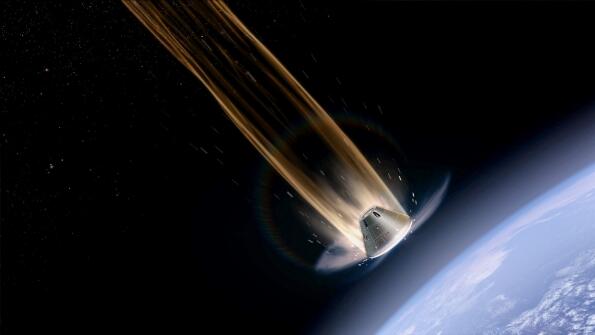
The Exploration Flight Test-1 capsule's heat shield braved 4,000F temperatures during the final minutes of the flight and appeared intact. Orion's avionics were rock steady as well.
In NASA’s Mission Control center, agency spokesman Rob Navias said Orion achieved a “bullseye” landing.
The heavily instrumented capsule was encircled quickly by recovery forces from NASA, Lockheed and the U.S. Navy. The capsule was met by the USS Anchorage amphibious ship and USNS Salvor salvage ship, along with small boats and divers.
Their assignment was to stand by for an extended, one-hour power down of the battery-powered capsule, allowing for the gathering of thermal data from the structure and the interior of the capsule as it cooled from its peak thermal exposure during atmospheric re-entry.
Once NASA Mission Control lead flight director Mike Sarafin gave the okay, the recovery teams were to move in, secure the capsule with a horse collar and tow it into the well deck of the Anchorage. Salvor's sailors are responsible for recovering the capsule's parachutes and their jettisoned protective thermal covers for post-flight analysis.
Before the mission, Jeff Angermeier, the NASA ground systems development and operations manager, estimated the Pacific recovery phase would take six hours.
The voyage back to U.S. Navy Base San Diego is expected to take two days. During the trip to port, the capsule will be repositioned in the Anchorage well deck from a perch atop a collection of speed bumps to a special cradle to hasten offloading at Mole Pier.
At the pier, NASA engineers hope to gather core samples of Orion's heat shield and retrieve at least some of the "black box" recorder data. More than 1,200 sensors placed throughout the capsule sent stress, thermal, pressure and other data to onboard recorders for assessments by engineering teams.
The capsule will be loaded aboard a flatbed truck for a trip to its Florida processing facility at NASA's Kennedy Space Center. A pre-Christmas return is anticipated, according to Angermeier.
Orion could launch again on a future unpiloted test flight, depending on its condition.
Orion lifted off from Cape Canaveral Air Force Station, Florida, at 7:05 a.m. EST, with a lengthy agenda of test objectives. They included the pre-programmed jettisoning of 17 structural components as they completed their ascent and on-orbital tasks and the deployments of 11 parachutes.
The chutes succeeded in slowing Orion from its top velocity of 20,000 mph as it dipped back into the Earth's atmosphere to 20 mph as it entered the water.
The Delta IV Heavy's second stage boosted Orion to a peak altitude of 3,604 mi. at 10:11 a.m. EST, to set up a lunar-like return not executed by NASA since the return of Apollo lunar missions between 1968 and 1972.
The Delta IV second stage separated as planned 10:27 a.m. EST, on a trajectory that was to place it into the Pacific north of Hawaii.
During the final stages of the capsule's atmospheric descent, it was met by Navy P-3 Orion aircraft, helicopters and NASA's Ikhana, a Predator-B drone. The pilots assisted the recovery ships with the capsule’s final heading and all of the aircraft gathered imagery for additional engineering analysis.