
Ordinary Goes to Space
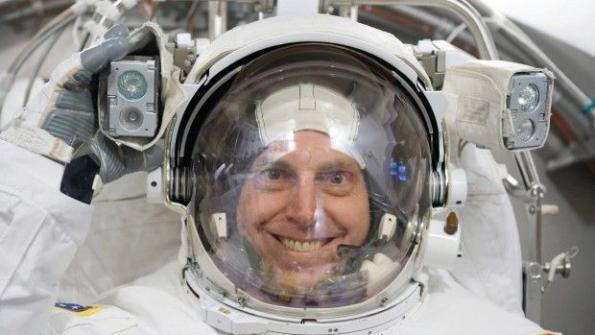
Retired NASA astronaut Clay Anderson's autobiography, The Ordinary Spaceman: From Boyhood Dreams to Astronaut, takes a hard look at the often stressful lives and personal struggles of America's shuttle and space station era pioneers and their management, including his own career limiting battle with emotional control, as they forge the international partnerships that have become the hallmark of future exploration.
His is hardly a household name. The lanky native Nebraskan holds the not so enviable record for the most attempts by an aspirant to claw his way into NASA's now shrinking astronaut corps, applying 15 times over 15 years. His 1998 selection led to 167 days in space, including five months aboard the International Space Station, and six spacewalks over two flights, the last concluding in April 2010.
Within seven months of his final return to Earth, Anderson was informed by his management that he lacked the temperament for long-duration spaceflight, NASA's only near term human spaceflight focus, after he fired off an internal e-mail with a vulgarity written in frustration over fumbled work related travel arrangements.
It was not his first faux pau in a competitive work place that occasionally includes extended unforgiving periods of time in the public eye while in the demanding, risk filled space environment. Anderson openly acknowledges as much in Ordinary, published June 1.
"It's tough to admit, but on some of this they were right," he writes after a session with management over several earlier confrontations with Mission Control that resulted from his criticism of daily scheduling and planning issues that arose during his 2007 space station mission.

However, perhaps not since Walt Cunningham's The All-American Boys, has an astronaut offered such insight into the often unglamorous hurry up and wait lives of the men and women driven by high expectations of opening the final frontier. Success often depends on how well then can throttle back those expectations by compartmentalizing their personal and professional lives. The stresses as well as the rewards can sometimes become too much not only for the astronauts themselves but their families, who after all are in most ways pretty ordinary.
The author opted for early retirement from NASA in early 2013, after 30 years with the agency -- all fueled by his boyhood exposure to Apollo 8, the 1968 mission that launched three Americans around the moon over Christmas.
To most of us the post Apollo-era astronauts are largely unfamiliar. Notoriety escapes them unless they become victims of terrible tragedies like those who perished aboard the shuttles Challenger and Columbia, or they do something terribly outrageous -- like the former diaper clad female astronaut who in a fit of jealousy drove cross country to confront the girlfriend of a male colleague.
Anderson's passion for his hard fought career, the space program's goals as well as his strong faith and devotion to his wife and two children leaps from all 400 pages of his autobiography and especially when he offers a most compelling behind the scenes account of the Feb. 1, 2003 shuttle Columbia tragedy.
Still four years from his first launch, Anderson agreed to serve as one of four escorts for the seven Columbia astronauts' family members at the request of shuttle commander and friend Rick Husband. As tradition, the four escorts were to be at the sides of the wives, husbands and children of the Columbia astronauts before and close by during the 16-day flight that ended with a fatal inflight breakup in the skies over Texas.
Columbia was descending to a landing at the Kennedy Space Center.
Anderson and the other escorts were at the Florida runway with the anxious Columbia family members to await the orbiter's early morning return and would quickly be called upon to share in the responsibility for disclosing the deaths.
"We don't know exactly what happened, but there is no hope. We must tell them," the escorts were instructed by NASA management.
"I rose with new resolve," Anderson writes. "Now was the time for me to be stronger than I had ever been in my life."
And he was strong until rejoining his wife, Susan, a NASA executive, and their young son and daughter, Cole and Sutton, upon his return to their Houston area home.
Anderson describes his tear filled reunion -- not the sort of things most astronauts would choose to share, but altogether human.
Painfully, Anderson and his family confronted the risks of his profession and the oft understated burden on those closest to the astronauts as they mourned the loss of colleagues, friends and playmates.
Ordinary's message is compelling: Exploration is not for the faint of heart, though not necessarily always carried out by those brimming with the mythical "Right Stuff" -- a message too often lost in the overarching battles over budgets and destinations.
Anderson's reflections are often blunt, sometimes tinged with TMI (too much information) and at times even crude as he delves into the details of spaceflight training, mission operations and after hours gatherings.
His not so welcome emotional resolve springs forth during a snow drenched Wyoming survival training exercise in which his persistence finally convinces his fellow astronauts to forsake allegiance to their activity timeline for a retreat to the safety of the previous night's camp site. This Midwesterner knows a dangerous blizzard when he sees one, Anderson writes.
He exercises his TMI reflex with a description of the toilet outside NEEMO, an underwater encampment off Florida's Atlantic coast used to prepare astronauts for the isolation of the space station.
Anderson is toughest on his colleagues in management roles but never tougher on them than he is on himself - a self-professed work in progress.
If he's as "ordinary" as he claims, Anderson's down to Earth account of the astronaut's life may help more of us to connect with the profession's forward looking significance -- a welcome addition to the outreach successes of Hollywood's Box Office and NASA's social media salvos.