
ISS Fluid Dynamics Experiment: Fresh-Brewed Espresso
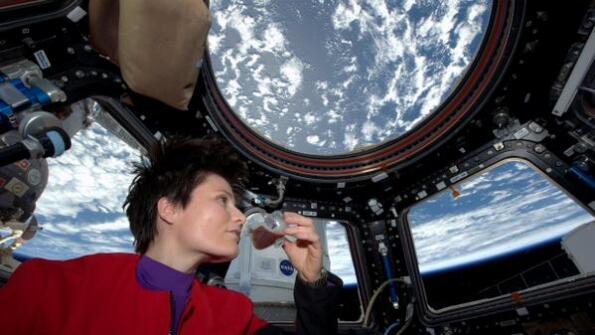
It was early May 3—8:44 a.m. EDT, to be precise—when European Space Agency astronaut Samantha Cristoforetti placed her lips to a straw and sipped a rich espresso blend, concocted and brewed with all the creativity of her native Italy.
It was a much anticipated first for the International Space Station, the introduction of a new staple for future space pantries, whether aboard a spacecraft locked in Earth orbit, in transit to an asteroid or Mars, or perhaps part of the daily menu at a human lunar base.
The build-up to the space espresso milestone seemed to rival that of the production of the first 3-D components aboard the six-person orbiting science lab in November and December with a prototype additive manufacturing printer developed by California-based Made in Space, Inc.
In some small way, each of these breakthroughs seems to make human spaceflight a little more down to Earth, always a risk-filled undertaking, but carried out by men and women still very much connected to the conveniences and joys of their native countries, whether its knowing the parts and tools for simple repairs may soon be as accessible as a trip to a home improvement store on Earth or drawing joy from the aroma and taste of a favorite beverage.

The 55-lb. ISSpresso machine, developed by Argotec and Lavazza, both of Turin, in partnership with Italian space agency ASI, reached the ISS on April 17 aboard the sixth SpaceX Dragon commercial resupply mission.
On May 3, Cristoforetti completed the installation and later transmitted a photo via Twitter of herself poised in the station's Cupola observation deck sipping the brew from one of six experimental "Space Cups."
While it's "just coffee," the machine itself required some intense engineering by the partnership to overcome the differences in fluid dynamics between brewing coffee on Earth and in zero-gravity environments at high temperature and pressure. There's lots of redundancy in the ISSpresso machine for safety, and it has a special feature that releases a burst of aroma when a drinking straw is inserted into the pouch typically used to hold space drinks.
ISSpresso accommodates the use of coffee capsules similar to those now popular in home and office coffee-makers to satisfy a wide range of tastes. The brewing device is suitable for a variety of tea and herbal infusion capsules as well as broth to add flavor to the freeze-dried rations already available to astronauts.
Cristoforetti demonstrated the operation, first filling a plastic pouch with water from the ISS water supply, then coupling the flexible container to the machine. The plastic coupler tube on the terrestrial coffee maker is replaced with a steel tube on the ISSpresso version to deal with the higher pressures. The hot fluid is then exposed to the inserted coffee pouch and routed through the machine to the astronaut's squeezable drink pouch.
However, that's not the end of the space espresso story.
A complementary research project using the new Space Cup will unfold in the coming weeks.

Future versions of the oddly shaped cups are to be manufactured with 3-D printing techniques to investigate the forces of surface tension in governing the movement of fluids in zero g. In addition to enabling astronauts to drink espresso in the space station from an open container like the one held by Cristoforetti, the findings could be crucial to the storing and delivery of fuels to rocket engines or medicines to the ill in space and on the Earth.
The additions of cream and sugar to the coffees and teas selected by the ISS astronauts as they combine the ISSpresso products with the zero-g Space Cup will help to serve as variables for the research, according to a recent NASA explanation provided by researcher Mark Weislogel, a Portland State University professor of mechanical engineering.
"With this cup, most everything is taken care of passively by the shape of the cup," he explained. "There isn't a straight line in it. There are no moving parts. Wouldn't it be nice if all the fluid systems on spacecraft worked like that?"