
Dragon Capsule Returns From Fifth Contracted Space Station Resupply Mission
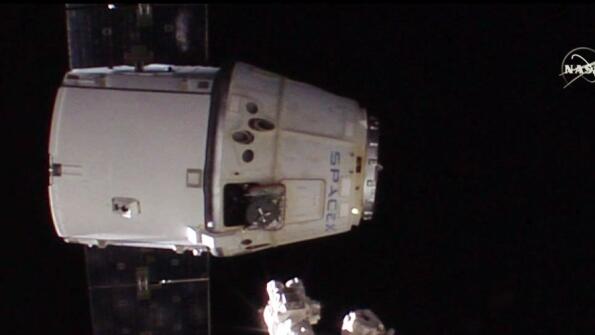
SpaceX recovery forces gathered at the Pacific Ocean splashdown site of the company’s fifth Dragon re-supply capsule late Tuesday, several hours after it departed the International Space Station with nearly 3,700 pounds of science equipment, crew hardware and trash.
The capsule splashed down under parachute, SpaceX confirmed at 7:45 p.m., EST. The targeted recovery zone was 260 miles southwest of Long Beach.
A 150 foot long recovery ship with A-frame crane, four smaller inflatable boats, a dozen engineers and technicians as well as dive crews were standing by to hoist the well-traveled capsule aboard and head back to port in Southern California.
The commercial freighter departed the station after its release from the grasp of Canada’s robot arm at 2:10 p.m., EST. European Space Agency astronaut Samantha Cristoforetti, who controlled the crane like robot arm from within the station’s Cupola observation deck, congratulated Hawthorne, Calif., based SpaceX for its smooth cargo operations.
The supply capsule moved safely out of range of the station for a 6:49 p.m., EST, de-orbit maneuver.
The Dragon, the fifth launched by the company under a $1.6 billion, 12-flight NASA agreement, was berthed on Jan. 12, two days after it lifted off atop a Falcon 9 rocket from Cape Canaveral Air Force Station, Fla.
The just over 5,100 pounds of new supplies included crew provisions, research equipment for dozens of scientific investigations and technology demonstrations underway aboard the six person orbiting science laboratory and spare parts.
One of the largest deliverables was the Cloud Aerosol Transport System, a new LIDAR environmental sensor that was installed outside the station’s Japanese Kibo research module on Jan. 22 to monitor air pollution. Some of the deliverables were as small as the fruit flies, roundworms and flatworms that served as roundtrip subjects in experiments devised to examine the effects of weightlessness on the immune system, nerve regeneration and bacterial virulence.
Among the return items were two fan pump separators that circulate air and cooling water in the space suits worn by spacewalking U. S., European, Japanese and Canadian astronauts. Both fan pump separators failed checkouts aboard the ISS in December and January.
Engineers are to investigate the cause before NASA embarks on a series of spacewalks to reconfigure two ISS docking ports for use by future commercial crew transportation providers Boeing and SpaceX. The spacewalks by astronauts Barry “Butch” Wilmore and Terry Virts are tentatively set to begin Feb. 20.
A failed fan pump separator was blamed for the July 2013 incident in which the NASA space suit helmet worn by ESA astronaut Luca Parmitano filled with cooling system water, prompting his hasty retreat to the airlock.
The return hardware also included the first samples from the prototype Made In Space 3-D printer aboard the space station. Engineers are hopeful that additive manufacturing will one day contribute to the resources needed by astonauts embarking on missions of deep space exploration.