
Chandra X-ray Observatory Captures Mega Milky Way Black Hole Outburst
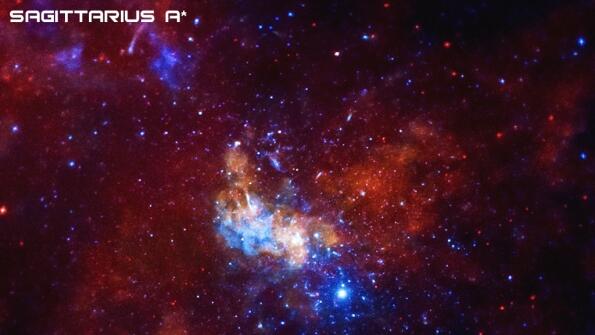
A pair of unusually intense X-ray flares coming from Sagittarius A*, the massive black hole that resides at the heart of the Milky Way galaxy, may have been triggered by the destruction of a captive asteroid or the tangling of strong magnetic field lines, according to observations made with NASA's venerable Chandra X-ray Observatory.
The findings were presented before the American Astronomical Society, which is gathered in Seattle this week for its winter meeting.
On Sept. 14, 2013 Chandra recorded the largest X-ray flare observed from Sgr A* during observations by an international observing team initially interested in interactions between the black hole and a nearby interstellar gas cloud. The black hole has a mass estimated at 4.5 million times that of the sun.
The outburst released 400 times the energy of the black hole's normal X-ray state, three times more intense than the previous mega flare record from early 2012.
The phenomenon repeated Oct. 20, 2014, with a mega flare about 200 times brighter than usual.
The gas cloud, designated G2, was deemed too far from SgrA* to be the trigger.
"However, nature often surprises us and we saw something else that was really exciting," noted lead researcher Daryl Haggard of Amherst College in a NASA announcement describing the discovery.
Launched aboard the space shuttle Columbia on July 23, 1999, Chandra is one of four in the series of Great Observatories launched by NASA to study the universe in different wavelengths. Chandra has been observing Sgr A*, which lurks 26,000 light years from the Earth, since achieving operational status.
The 15 scientists from the U.S., Canada, Germany and the Netherlands remain puzzled about the source of the mega flares.
But their first theory points to an asteroid that came close enough to the black hole's massive gravity to be torn apart. The debris grew hot, producing X-rays before falling into SgrA*.
"If an asteroid was torn apart, it would go around the black hole for a couple of hours like water circling an open drain before falling in,'' notes MIT's Fred Baganoff, another of the researchers. "That's just how long we saw the brightest X-ray flare last, so that is an intriguing clue for us to consider."
The second theory is less exotic. It holds that magnetic field lines within gas flowing towards Sgr A* could be tightly packed and become tangled. When the field lines occasionally reconfigure, they produce a bright outburst of X-rays, similar to magnetic flares associated with the sun.