
1961: Higher And Faster In The X-15
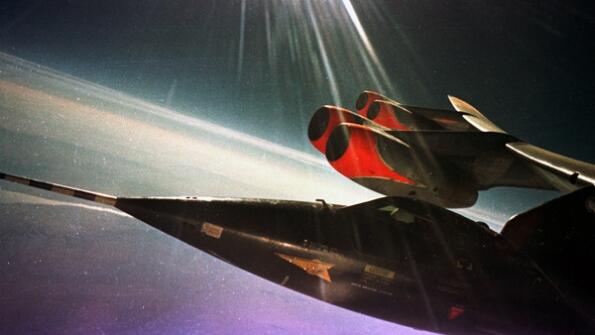
Fifty five years ago this week test pilot Scott Crossfield flew the North American Aviation X-15 rocket plane on its first powered flight. Conceived as a hypersonic research vehicle, the X-15 would go on to pave the way for space shuttle operations and provide a wealth of data about high speed flight, systems, structures and aerodynamics. By the time Aviation Week took an in-depth look at the program in November 1961, the X-15 had already blasted its way to an altitude of 217,000 ft. and a record speed of Mach 6.04. Eventually the aircraft would be pushed well beyond its original design limits with NASA test pilot Joe Walker reaching an altitude of 354,200 ft. and U.S. Air Force test pilot William ‘Pete’ Knight achieving a top speed of Mach 6.72 (4,520 mph) in the X-15A-2 version in October 1967.

At the time of the Aviation Week story, the X-15 was actually slated to end in 1963 before the start of the planned X-20A Dyna-Soar spaceplane. The X-20A was cancelled by U.S. Defense Secretary Robert McNamara in 1963, and the X-15 enjoyed a new lease of life as a flight test asset. Amongst many achievements, the X-15 program is credited with proving that a high speed vehicle re-entering the sensible atmosphere like the space shuttle could glide to a precision landing using a maneuver called Terminal Area Energy Management. The origins of this concept are well explained in this fascinating first-hand account of the classic days of flight testing at Edwards AFB, California.
► Read the report in the November 20, 1961 issue of Aviation Week & Space Technology:
X-15 Objectives Raised to New Limits (part 1)
X-15 Objectives Raised to New Limits (part 2)
► Aviation Week is approaching its 100th anniversary in 2016. In a series of blogs, our editors highlight editorial content from the magazine's long and rich history, including viewpoints from the industry's most iconic names and stories that have helped change the shape of the industry.