
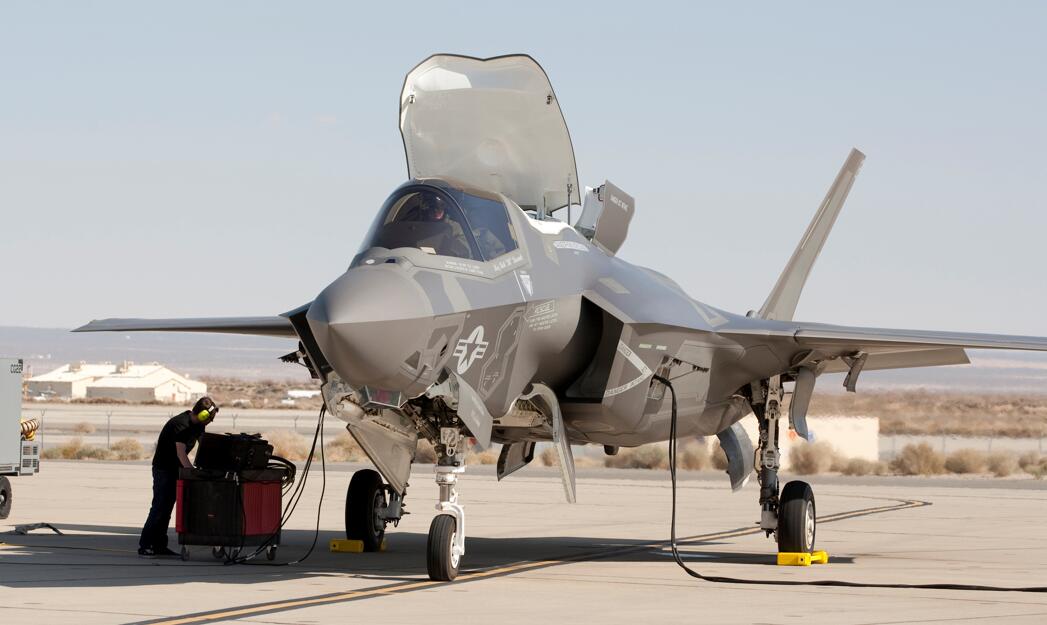
F-35B
COLORADO SPRINGS and EAST HARTFORD, Connecticut—As a U.S. Defense Department decision looms over the potential future use of adaptive engines in the Lockheed Martin F-35, General Electric says a study has concluded that the XA100 advanced propulsion system could work in the short takeoff and vertical landing (STOVL) variant.
But rival Pratt & Whitney, which continues test and development of its own XA101 adaptive engine, remains critical of GE’s proposal—particularly for the STOVL variant. The study result comes as Pratt steps up a campaign to push the advantages of developing an F135 enhanced engine package (EEP) upgrade as a more practical and affordable alternative to replacing the existing powerplant with an all-new, three-stream propulsion system.
The GE XA100 STOVL option study was undertaken with the F-35 Joint Program Office (JPO), Lockheed Martin and Rolls-Royce—the provider of the lift fan system that enables the F-35B version to operate in STOVL mode. The study outlined the feasibility of modifying the variable-cycle engine for operation in future versions of the F-35B now flown by the U.S. Marine Corps, Japan, the UK, Singapore and Italy.
The results were completed in time for the fall meeting of the JSF Executive Steering Board and evaluated how the XA100 fan and compressor could be modified for the role. This included ways to attach the new low-pressure system to the drive shaft and gearbox clutch that drives the lift fan. Other changes required included integrating the XA100 with the roll posts and other elements of the lift system.
GE says the evaluation, which was supported by Lockheed Martin, was recently concluded “for the F-35 Joint Program Office, which looked at how we would address the unique B-variant integration requirements. It was a collaborative and productive effort, and we were happy that our results showed a path that could meet the customer’s technical goals.”
Pratt & Whitney is skeptical of the capability of GE’s adaptive engine to fulfill the current F-35B mission. Jon Niemeyer, chief engineer at Pratt & Whitney for the F135, says “All adaptive motors are heavier than today’s. You start looking at STOVL as an application, but what happens to the weight, especially where weight is a key parameter? So that combination of getting the increased weight plus increased power demands with all this other stuff going on, can they actually even beat today’s motor?”
Speaking to Aerospace DAILY, Niemeyer adds that aside from the complexities involved in integrating an adaptive engine architecture to the unique offtake demands of the STOVL mission, “There’s a chance they [GE] can’t overcome the weight obstacle and meet the vertical landing bring-back [mission requirement for returning with unused stores] even if they compromise everything. Typically, it takes almost a two times factor in how hard you push the core to deliver capability in the lift fan.”
“If I’ve got bigger power offtakes, the low-pressure turbine needs to be redesigned to meet the amount of additional pressure ratio,” Niemeyer says. “So it’s most likely going to be increased diameter and increased length. And now the question is how do you make space for it? Now you have this adaptive architecture that’s got three streams, and that’s what allows you to generate commercial-like fuel burn by shifting the modes of the motor. As you start doing some of these changes on STOVL, you start compromising what a three-stream architecture was trying to do by consuming space in both directions.”
The challenge is made tougher in the F-35 by the need to install the new engine within the current confines of the fuselage. “It has to fit in an existing weapon system like the F-35, you now have to start talking about what am I going to do to the exhaust system to make it work. The nozzle for STOVL is unique; it’s not clear how you make that work,” he adds. “In my opinion everything’s solvable, always. The question is under what schedule and at what cost?”
Lawmakers, meanwhile, have sent a bipartisan, bicameral letter to the Defense Department, urging it to continue funding the development of adaptive propulsion systems for fighter aircraft in the Pentagon’s fiscal 2024 budget submission. The letter was penned by Sen. Rob Portman (R-Ohio), Sen. Sherrod Brown (D-Ohio), and Rep. Brad Wenstrup (R-Ohio), and warns that without continued support for new engine technology, “We risk opening the door for U.S. adversaries to overtake our advantages.”
In this area at least both GE Aerospace and Pratt & Whitney appear to be on common ground, as work on the XA100/101 comes toward an end under the current Adaptive Engine Transition Program (AETP). Pratt & Whitney says it “is committed to the continued maturation of the technology suite in AETP, as it is foundational for the 6th Gen capabilities needed for the Next Generation Air Dominance (NGAD) family of systems in the 2030s.”
Although initial adaptive engine study contracts were issued in August for the prototype phase of the Next Generation Adaptive Propulsion (NGAP) engine program for NGAD, it remains unclear whether funding for additional rounds will be secured for the fiscal 2024 budget and beyond. The existing awards were made to GE and Pratt & Whitney in addition to Boeing, Lockheed Martin and Northrop Grumman.
Coming two years after the acknowledged first flight of at least one prototype demonstrator vehicle, the awards also indicated the two engine makers were stepping up the level of propulsion integration work with the airframe manufacturers. The engine contracts emerged after the Air Force declared it is planning to ramp up spending on the NGAD program ahead of fielding by 2030, with $1.657 billion in research, development, test and evaluation funding.

Comments
One could argue that the [forced commonality of the] F-35B has compromised the F-35A and F-35C.