
10 Things To Watch In The 2016 Budget Request
Six years into his presidency, President Barack Obama is planning to finally submit his budget request to Congress on time—meaning the week of Feb. 2 this year. In it, he will deliver what is likely to be his last meaningful budget push, as the president's final budget request is made during a lame duck year. Defense officials are hoping that sequestration—mandatory deep cuts dictated by Congress—are behind them. But it is still technically the law of the land. The Pentagon intends to submit its budget with the assumption that sequestration will not take effect in fiscal 2016 and beyond. Should it remain in effect, several programs will suffer in a major way.
Against that backdrop, I have assembled a list of 10 programs I plan on watching closely on budget day and beyond—as Congress reviews the request (which could take a while, considering Congress has not typically done so in a timely manner).
Consider these a guide. Not all major programs are included here. For example, I did not include F-35 development and procurement in the list because it is highly unlikely that the Pentagon will reverse its plans for the single-engine fighter.
Please feel free to write in the comments sections other programs worth watching as the fiscal 2016 budget, likely to be over $500 billion, rolls out in the coming weeks. I ranked this in order of budgetary and strategic importance, but each of these issues is significant in its own right.
(Note: Most of the links to stories below require a subscription.)
New Rocket Engine: Amid a political fracas after Russia annexed Crimea last year, U.S. policymakers have grown weary of continued reliance on NPO Energomash, a Russian company, for supply of its RD-180s. These power the popular and efficient Atlas V, built by United Launch Alliance (ULA). Last year, the Air Force said a new engine for the Atlas V—or a new engine for a new rocket—would cost at least $1 billion. The forthcoming budget is likely to provide clues on the acquisition strategy to develop and buy this engine.
USAF Commission Urges New Engine To Mitigate Atlas V Gap
Launches up for Grabs: With ULA having won 28 missions (36 engine cores' worth of work) over five years, it will be interesting to see how the launch manifest shakes out in the forthcoming budget plan. Launch upstart Space Exploration Technologies (SpaceX) is expected to be certified to compete with ULA for national security launches by June, and SpaceX is eager to begin earning work for the Pentagon and intelligence communities. The Air Force also is under pressure to open up some launch missions for competition, as SpaceX’s lawsuit, alleging ULA’s five-year deal was unfairly awarded, remains unresolved.
Certification Process Slows SpaceX’s Market Push
SpaceX Sues USAF, Seeks Vertical-Landing Permission

Credit: NASA
Unmanned Carrier-Launched Surveillance and Strike (Uclass) Aircraft: The Navy’s decision on whether to move ahead with Uclass will be a strategic bellwether for the service’s ambitions in unmanned aircraft technology. The Navy has long sought a marriage of unmanned aircraft and the persistence and flexibility offered by aircraft carriers. Through Uclass, the Navy hopes to field a small number of unmanned intelligence-collecting aircraft on the carrier; eventually they would operate alongside F/A-18EFs and F-35Cs. Questions of whether to prioritize stealth over payload have plagued Uclass with delays. But, in the current fiscal environment, Pentagon officials are now wrestling not with how to proceed but whether to do so. Should the program move forward, bids are expected from Northrop Grumman, Lockheed Martin, General Atomics and Boeing.
Pentagon’s Kendall On Maintaining U.S. Technological Edge
Redesigned Kill Vehicle: Missile Defense Agency Director Vice Adm. James Syring is planning to reveal the Pentagon’s strategy to develop and procure a more reliable kill vehicle for the Ground-Based Midcourse Defense (GMD) system in the fiscal 2016 budget rollout. At issue is a tattered record for today’s Exoatmospheric Kill Vehicle (EKV), designed and built by Raytheon. EKV was crafted as a prototype and rushed into service in response to aggression from Pyongyang. Now, however, Pentagon officials have grown increasingly concerned that the kill vehicle is the weak point in an intricate kill chain for missile defense. Syring says he is looking at conducting a competition or forming a national team. Raytheon and Lockheed Martin are most interested in offering bids.
Pentagon’s New Kill Vehicle Strategy Expected Soon
Air Force One Replacement: Because buying an aircraft suitable for the U.S. president and his specialized role as commander-in-chief is so expensive, Air Force One programs are typically launched at the end of a two-term presidency. Then, the president faces no political ramifications for starting a costly executive-lift program and can hand a healthy program off to his successor. In the case of a replacement for two VC-25As based on the 484-200B in service today, the Pentagon is likely to select the 747-8 as a successor platform. What is uncertain is the amount of work the Pentagon will compete. Will the Air Force manage the integration or kick it over to industry?
USAF Eyeing New Presidential Aircraft

Credit: U.S. Defense Department
Sequestration Kills and Retirements: Remember that the Pentagon issued two budgets last year—one with sequestration and one without. The latter included possible cuts of such programs as a next-generation fighter engine, 24 fewer F-35s and a reduction in UH-72A Lakota purchases. And the “baseline” budget included retirements of the A-10 and B-1. Under sequestration, the Air Force was eyeing an earlier-than-planned retirement of the KC-10 refueler fleet. While some proposals—such as the A-10 retirement—landed with a thud on Capitol Hill, these are not off the table. The Pentagon has long argued that being forced to maintain excess force structure—hardware and facilities—siphons valuable money away from development and procurement programs.
House Opts To Keep The A-10
Hagel Outlines Defense Cuts If Sequestration Stays
U-2 vs. Global Hawk: The Pentagon is willing to pay for three more years of Lockheed Martin U-2 operations and invest about $150 million in upgrading the fleet of high-flying reconnaissance aircraft, a reversal of its earlier position to mothball the "Dragon Lady" in favor of an all-Northrop Grumman Global Hawk fleet. Pentagon leadership has been back and forth on this subject for years—raiding the accounts of one to benefit the other. It will be interesting to see if this is the only major shift in intelligence, surveillance and reconnaissance funding in the 2016 budget. Also up for a decision is whether the Air Force needs to buy a full 65 combat air patrol's worth of Reapers or truncate the buy, in light of the drawdowns in Iraq and Afghanistan and the struggle to train enough personnel to operate the UAVs it already uses.
Pentagon To Fund Three More Years of U-2 Operations

Credit: U.S. Air Force
F-35 Maintainers: F-35 Program Executive Officer USAF Lt. Gen. Christopher Bogdan has said that the toughest challenge to meeting the Air Force’s requirement to declare initial operational capability (IOC) for the Lockheed Martin F-35A by the end of 2016 is a shortage of maintainers for the first squadron. Air Force Chief of Staff Gen. Mark Welsh, however, is not budging from that date. Last week, he doubled down, noting that a mitigation plan can be implemented for the IOC date; it is likely to become more clear with the budget release next month.
U.S. Air Force Unlikely To Meet August 2016 F-35A IOC
USAF Still Targeting F-35A IOC By December 2016
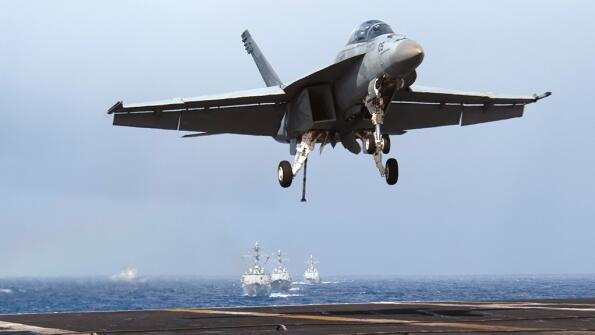
Fighter Strategy: Funding has begun to trickle and rhetoric has ramped up as the Pentagon considers a next generation of fighters that would eventually replace the Lockheed Martin F-22 and Boeing F/A-18E/F. It remains to be seen whether the Pentagon will force the Navy and Air Force to collaborate, though both are balking at the notion, citing as a rationale the quagmire that F-35 has been. Pentagon procurement chief Frank Kendall says he’s concerned that budget pressure in Washington will erode the U.S. technical advantage. So it stands to reason the services will roll out a plan for the way ahead as Obama prepares to leave office in two years. Also the 2016 budget will reveal just how soon Boeing will have to shut down its F/A-18 and EA-18G production line in St. Louis, leaving Lockheed Martin’s Fort Worth facility as the only major fighter line in the U.S.
USAF, Navy May Part Ways On Next-Generation Fighters
Pentagon’s Kendall On Maintaining U.S. Technological Edge
Next-Gen Satellites: For years, the Pentagon has been studying options for follow-on programs to the costly Advanced Extremely High Frequency (AEHF) and Space-Based Infrared System (Sbirs) satellites built by Lockheed Martin. These satellites, especially AEHF, could be pioneers for the Pentagon’s hopes to “disaggregate” future constellations. The notion is to separate the tactical high-frequency comms mission from the strategic, nuclear-hardened comm mission in an effort to make the constellation more difficult to compromise in the event of an attack. The service is also examining whether it is feasible for the next-generation early missile-warning satellites to take advantage of advanced focal plane arrays for a simpler, less expensive satellite design. Another decision is whether the Pentagon will leap ahead to a new weather satellite program or launch the 20th Defense Meteorological Satellite Program spacecraft. Several contractors, including Orbital Sciences Corp., Ball Aerospace, Lockheed Martin, Boeing and Northrop Grumman area awaiting a weather satellite strategy.
2015 USAF Budget Request Step Toward Space 'Disaggregation'
Shelton Balancing Today's Cuts, Long-Term Vision