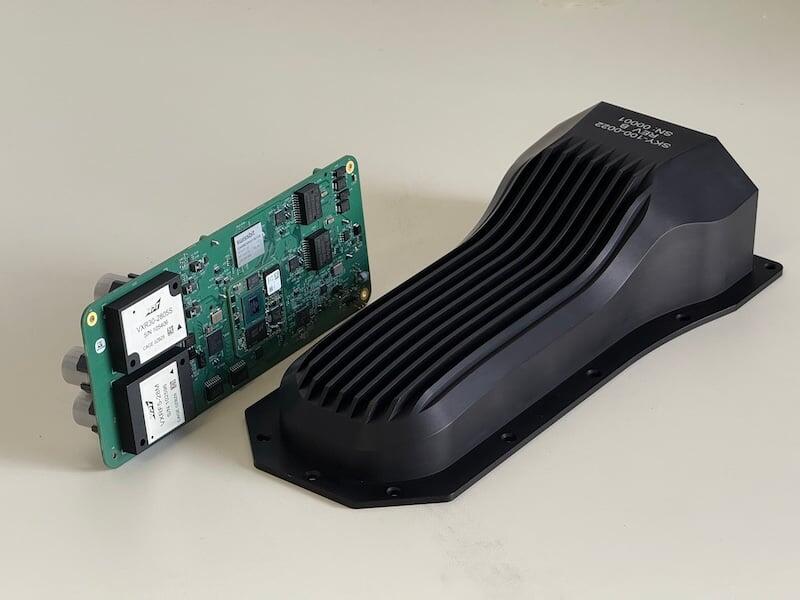
Skyband's M100 tightly couples Iridium's PNT microchip with a tactical-grade inertial sensor on a custom printed circuit board.
As interference with satellite navigation escalates, startup Skyband Systems has launched production of a unit using Iridium's low-Earth-orbit constellation to alert pilots to GPS jamming and spoofing and provide supplementary position and timing.
Kirkland, Wash.-based Skyband is working with avionics installer AeroMech to certify the M100 system in its first application, an Embraer Praetor 600. FAA supplemental type certification (STC) on the business jet is targeted for November, the startup says.
Interference with global navigation satellite systems (GNSS) has risen sharply in recent years: GPS jamming events reported in 2025 increased 67% compared with 2023, while GPS spoofing incidents rose 193%.
Skyband's M100 combines Iridium's encrypted position, navigation and timing (PNT) service with an inertial measurement unit (IMU) to address GPS interference by providing a globally available navigation solution independent of GNSS signals. The M100 connects with the aircraft's existing Iridium satellite communications antenna and outputs to the flight deck via an electronic flight bag (EFB) application and a cockpit annunciator. Initially, the system will be approved for pilot situational-awareness assistance only to minimize the hurdles to certification.
Skyband was founded in January by two former SpaceX Starlink executives, Will Seidel and Robert Wiggenhorn. “I ran the aviation department at SpaceX. We were putting Starlink internet on aircraft,” says Seidel, the startup's CEO. “At Starlink, Robert was responsible for everything that wasn't consumer aviation.”
Skyband President Wiggenhorn was also responsible for Starlink's planned PNT product, which has yet to be launched. “It was frustrating to me that, at SpaceX, there are some technologies that we had at our fingertips that we could bring to bear,” says Seidel. “The big gap was who was going to certify it for aircraft?
“But the one thing I'm pretty darn confident we can do is certify an avionics box to get on an aircraft because we've put tens of thousands of Starlink systems on aircraft already,” he says.
The team was also familiar with Iridium, Seidel says, having helped launch its satellites while on the rocket side at SpaceX. “They were bringing out this PNT solution and looking for someone to certify it on aircraft,” he says. “We're fusing the Iridium PNT product with a high-performance IMU to create a resilient, very hard to jam system.”
Signals from Iridium's LEO satellites have a signal-to-noise ratio of 30 dB, 1,000 times stronger than those from GNSS spacecraft in medium Earth orbit, making them harder to jam. “It is also cryptographically protected, so it is much harder to spoof,” Seidel says.
Skyband has designed and built a custom printed circuit board assembly and validated end-to-end performance over 17 test flights, beginning Sept. 25. M100 units are now in production, with qualification testing planned this month, the company says.
Standards for dual-frequency, multi-constellation GNSS receivers that are more resilient to jamming and spoofing, as well as anti-jam controlled-reception pattern antennas, are still in development, and certified equipment is not expected to be available before 2030. “It's not the technology that's the problem, it's the regulatory framework,” Wiggenhorn says. “That's what we learned firsthand at SpaceX, so we built the technology and the company around how we accelerate getting this to market within the constraints of the existing framework.”
Initially, the M100 will be certified to design assurance level DAL D, a minor failure condition, to ease certification. “It will have a cockpit annunciator light to tell the pilot if they're being jammed or spoofed, so we can do it in a low certification barrier way,” he says. “A mobile app will allow pilots to get additional information on what their actual navigation is. We can compare the positioning solution we get with our box with what the aircraft sees,” he adds. “The regulatory framework for EFBs is much easier and more flexible.”
Iridium operates in L-band, as does GPS, but at an adjacent frequency. “If GPS is being specifically targeted, Iridium would not be impacted,” Wiggenhorn says. While a software-defined radio could jam any L-band frequency, Iridium's stronger signal would reduce the area affected. “If you're jamming a 100-km-radius area on GPS, then you would be jamming a 3-km radius area on Iridium—a pinhole versus an entire country, which is what's happened today,” he says. By relying on the M100's tactical-grade IMU for several minutes, the aircraft can fly through the much smaller denied area.
Delivered via the 66-satellite Iridium Next constellation, the PNT service requires one dedicated channel on an existing Iridium satcom terminal. “If a customer already has an Iridium comms antenna, and has an extra channel, we can use that. If it's a two-channel antenna and is full, we can swap it out for a three-channel Iridium antenna,” he says.
The cockpit annunciator, a light labeled “GPS UNREL” added to the panel, illuminates when the M100 indicates GNSS signals are unreliable. “That light plate has to be customized to the cockpit,” says Seidel. “We're working on the Embraer Praetor 500 and 600 and Legacy 450 and 500, so we're complying with the Embraer dark cockpit philosophy.”
In a standard installation, data from the aircraft's GPS and some other systems are fed to the M100. “We don't use GPS for our solution, we're just reading what the aircraft GPS sees so we can compare it with our solution to see if GPS is being jammed or spoofed,” says Wiggenhorn.
“We have no downstream dependencies on GPS,” Seidel says. “That means we are truly independent, unlike many legacy avionics systems that end up having GPS dependencies they didn't know they had. There are some business jets where the toilet is disabled if you lose GPS.”