
AW&ST HUB | AEROSPACE | DEFENSE | SPACE | COMMERCIAL AVIATION | MRO
Latest Space Content By Aviation Week & Space Technology

Jun 25, 2012
The U.S. Air Force is gearing up to set another round of firsts with the pending third launch of the Boeing X-37B, but what those milestones may be will remain as much of a mystery as it has been with the recently completed second flight. Looking relatively pristine after its fiery reentry through the atmosphere, the second X-37B Orbital Test Vehicle (OTV-2) completed a record-breaking 15-month classified mission with a textbook autonomous landing at Vandenberg AFB, Calif., on June 16.

Jun 25, 2012
Intelsat makes mobile play with new satellite platform

Jun 25, 2012
In the mid-1990s, the U.S. government decided to merge its military and civilian polar-orbiting weather satellite programs, because they shared a number of similarities. The combination of future weather-satellite systems into a single program, designated the National Polar-orbiting Operational Environmental Satellite System (Npoess), was justified as a cost-saving measure. Consequently, military-civilian weather satellite ground control stations were integrated into NOAA facilities at Suitland, Md.

Jun 25, 2012
Shenzhou 9 should build confidence as China plans to assemble a space station

Jun 25, 2012
The independent organization that NASA selected to run National Laboratory work on the International Space Station may be off to a slow start, but outside “pathfinders” on the ISS are demonstrating ways to use its unique environment that already fall outside traditional government methods.

Jun 25, 2012
Astronaut Don Pettit is a real Mr. Fixit, and that is just fine with the scientists who trust him to run their experiments on the International Space Station.
Jun 25, 2012
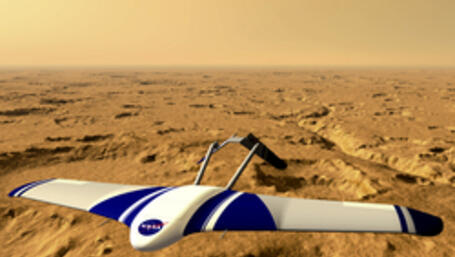
As NASA mission planners wait with bated breath for the Mars Science Laboratory to scream into the Martian atmosphere at hypersonic speed on Aug. 5, deploy its braking parachute, fire its retro-rockets and lower the Curiosity rover by tether to a soft landing, thoughts are again turning to exploring the red planet from the air.

Jun 18, 2012
Spacecraft engineers at NASA's Jet Propulsion Laboratory (JPL) hope to land the Mars Curiosity rover closer to its target than originally planned, moving the “sky crane” touchdown about 4 mi. nearer the base of the mountain where scientists seek to explore layers of sedimentary rock for evidence that a wetter Mars could have supported life.