
AW&ST HUB | AEROSPACE | DEFENSE | SPACE | COMMERCIAL AVIATION | MRO
Latest Space Content By Aviation Week & Space Technology
Mar 25, 2013
The final chapter has apparently opened in the turf war among national security agencies over which should control the most prominent weapon system in use since the 9/11 terrorist attacks.
Mar 18, 2013
Is not rushing to secure longer-term, more efficient deals
Mar 18, 2013
Australia's startup satellite operator NewSat will launch the Jabiru-1 satellite in early 2015 after spending several months finalizing more than $400 million in export-credit-agency financing.
Mar 18, 2013
Companies that market Russian and Ukrainian launch services are banking on their hardware suppliers to get their acts together— and on continued demand for satellite launches—to keep satellite operators returning their telephone calls in the face of ongoing quality-control problems plaguing the once-proud space industry set up by the former Soviet Union.

Mar 18, 2013
Export-credit agencies becoming fixtures in global satellite market
Mar 18, 2013
With no takers among cash-strapped European governments, EADS Astrium is talking to Singapore about partnering on the GO-3S space surveillance system, a geostationary satellite that promises to be the first to transmit real-time video resolving objects as small as 3 meters (10 ft.) across.

Mar 18, 2013
This gray powder from inside a Martian “mudstone” contains sulfur, nitrogen, hydrogen, oxygen, phosphorous and carbon—all chemical ingredients for life as we know it on Earth and a major target of the $2.5 billion Mars Science Laboratory (MSL) mission. In a first for planetary science, the mission's nuclear-powered Curiosity rover drilled the hole at left, after a test run to the right, and transferred some of the powder to its internal chemistry labs.
Mar 18, 2013
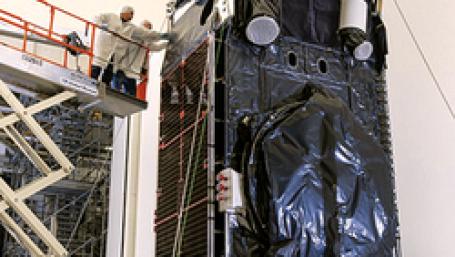
Unwieldy U.S. military procurement continues to hamper the use of hosted payloads as a time- and cost-saving way to put sensors and relays into orbit, even with a hosted UHF link serving troops and sailors in Afghanistan and the rest of the Indian Ocean region. That hosted payload on the Intelsat 22 bird belongs to the Australian Defense Force (ADF) and has worked well since its launch a year ago on a Proton. The ADF paid $167 million for the 18 UHF channels and had them up and running less than three years after it signed the contract.