
Latest Commercial Aviation Content by Aviation Week & Space Technology
Aug 06, 2012
As a passenger, it's evident that airlines are doing a much better job at managing their capacity. It's rare to find an empty seat next to you. Frequent fliers also know many airlines offer ancillary services—from onboard food to checked baggage—for a fee. New revenue streams are visible. What is invisible to passengers is that airlines also are getting smarter about managing life-cycle costs.
Aug 06, 2012
Centaur was conceived for scientific missions, but as the possibilities for optionally piloted aircraft (OPA) technology become more apparent, “we are actively thinking of what the next steps are,” says John Langford, president of Aurora Flight Sciences. In addition to enabling new types of missions that combine unmanned persistence with certified platforms, optional piloting could act as a bridge to the future by helping build trust in flying autonomous aircraft in the national airspace system (NAS).
Aug 06, 2012
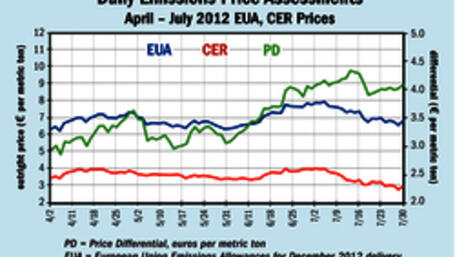
European Union emission allowance (EUA) prices fell sharply in July on renewed doubts that the system's regulator, the European Commission, would reveal new details on proposals to withhold future supply to prop up prices. EUAs for December 2012 delivery under the EU emissions trading system (ETS) fell to as low as €6.65 per metric ton ($8.19) by the close on July 30, down from €8.36 on July 5, a fall of 20.5%.

Aug 06, 2012
Wall Street is watching US Airways Chairman and CEO Doug Parker's play for American Airlines with great interest. Fending off Parker, American chief executive Thomas Horton says the carrier is looking at all options, including a tie-up with code-share partner Alaska Airlines—to which Alaska politely says thanks, but no thanks. “We have said for many years that our preference is to remain a strong, vibrant, independent company,” says Chief Financial Officer Brandon Pedersen. And contravening its usual stance on mergers, Wall Street largely agrees.

Aug 06, 2012
Avideo of a small unmanned helicopter dropping from hover like a stone, its operator unaware control has been hijacked, threatens plans to open civil airspace to UAS (unmanned aerial systems) by exposing the vulnerability of GPS to counterfeit signals, or spoofing. Although the weaknesses of civil GPS have implications beyond aviation—threatening the energy, financial and telecommunications sectors—they have come into sharp focus since Congress directed the FAA to open national airspace to UAS by 2015 (see p. 52).

Aug 06, 2012
In February, when Congress directed the FAA to open national airspace to civil unmanned aerial systems (UAS) by the end of 2015, it unleashed a flurry of regulatory and industry activity—and unlocked a closet of public and political concerns over how these systems could be used domestically.
Aug 06, 2012
After months of sharpening their bids and building teams, a U.S.-wide competition for the FAA to designate six sites to test UAS (unmanned aerial system) technologies in civilian airspace is about to begin. Across the country, governors, lawmakers, business development organizations, airports and companies are sharpening bid proposals that the FAA expects to issue “soon,” with an eye toward choosing the winning teams by year-end. Recent legislation requires the FAA to integrate UAS into the civilian airspace by Sept. 30, 2015.

Aug 06, 2012
It's the survival of the fittest in a highly competitive air transportation arena. And today, with few exceptions, Europe's legacy carriers are struggling to adapt. While this is not a radically new situation, uncertainties and tensions have never been so high, especially since the economy is weak and low-cost carriers are more aggressive than ever.