
Latest Commercial Aviation Content by Aviation Week & Space Technology
Oct 01, 2012
Careful succession planning is the hallmark of any well-managed company. Chris Kubasik may be taking over as CEO of Lockheed Martin at the beginning of 2013, but the company telegraphed his ascent back in 2010, when he was elevated to president. Louis Chenevert was eased into the position of chairman and CEO of United Technologies over several years. And General Dynamics has long been grooming Phebe Novakovic, who plans to succeed the retiring Jay Johnson as CEO on Jan. 1. Now Rockwell Collins has chosen an heir apparent for its longtime chairman and CEO, Clay Jones.
Oct 01, 2012
USAF Lt. Gen. (ret.) Dick Newton has been appointed executive VP of the Arlington, Va.-based Air Force Association, succeeding David T. “Buck” Buckwalter. Newton was assistant vice chief of staff/director of the air staff at USAF headquarters at the Pentagon.
Sep 24, 2012
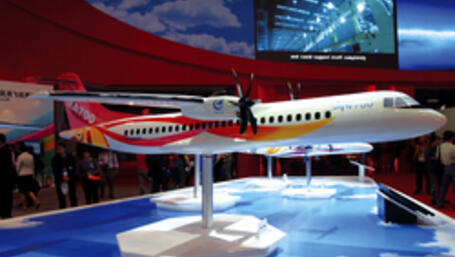
Xian is developing a twin-turboprop regional airliner dubbed the MA700. This aircraft is not an MA60 variant, but rather a clean-sheet design. Features include six-blade propellers, a T-tail and an unswept high-mounted wing. There are two versions of the MA700: one with 70-plus seats and one with 90-plus seats. A dedicated freighter variant has also been considered. Service entry of the MA700 is targeted for 2016 or 2017. Xian intends to pursue FAA and European Aviation Safety Agency certification for the MA700. The MA700 could replace the MA60/MA600 in production.
Sep 24, 2012
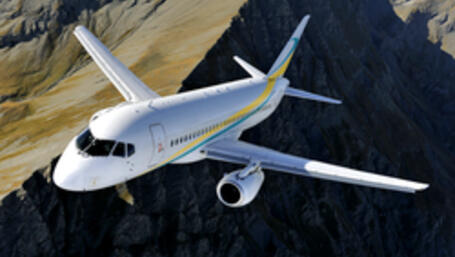
The Sukhoi Superjet 100, formerly known as the Russian Regional Jet, is a family of twin-engine transports powered by Snecma/NPO Saturn SaM146 turbofans, rated at 13,500-17,500 lb. thrust each. The series has been launched with the 95-98-seat baseline Superjet 100-95. The shortened 100-75, a 75-78-seat version, and stretched 100-115/120, a 115-120-seat version, are being considered. The Superjet 100-95 made its first flight in May 2008 and achieved initial Russian/CIS certification in early 2011; deliveries began in mid-2011.
Sep 24, 2012
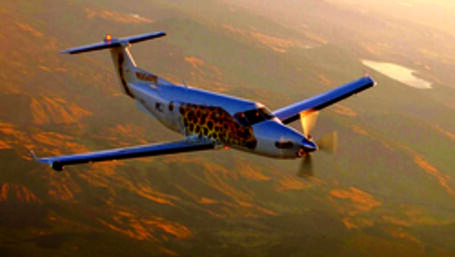
This pressurized, single-turboprop-powered, corporate/utility transport aircraft first flew in May 1991, and received Swiss and U.S. certification in 1994. It has seating for nine passengers in its standard layout. Portugal's OGMA assembles green aircraft and also manufactures some components. The current PC-12 production version, the PC-12 NG (Next Generation), is powered by a 1,200-shp Pratt & Whitney Canada PT6A-67P turboprop engine. The PC-12 competes with the Daher-Socata TBM 850, Cessna Caravan and Hawker Beechcraft King Air.
Sep 24, 2012
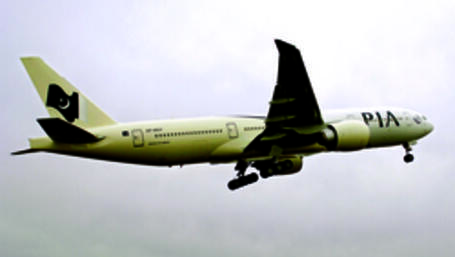
The 777 is a twin-engine, widebody commercial transport aircraft. First flight occurred in June 1994, followed by FAA/JAA certification in April 1995 (Pratt & Whitney-powered version). Deliveries began in June 1995. The 777-200ER version seats 301-440 passengers and is powered by two GE90, PW4000 or Trent 800 turbofans rated at 84,000-95,000 lb. thrust each. Two newer versions are the 777-200LR and 777-300ER. The -200LR, which seats 301 passengers in three classes, is powered by a pair of 110,100-lb.-thrust GE90-110B1 or 115,300-lb.-thrust GE90-115BL turbofans.
Sep 24, 2012
Airbus and Boeing may have sought to fortify their dominance of the narrowbody jet market by offering reengined versions of the A320 and 737, but Bombardier is proving to be a scrappy challenger. The Canadian airframer's recent move to squeeze another 11 seats into its new CSeries jet—for a total of 160—appears to have increased the aircraft's appeal.
Sep 24, 2012
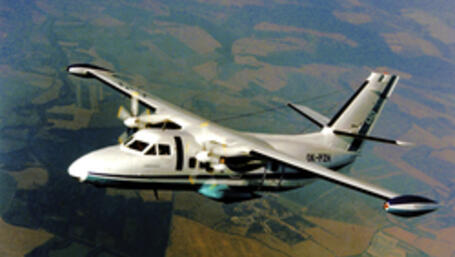
This 15-19-passenger, unpressurized, twin-turboprop-powered, regional/utility transport aircraft is powered by two General Electric M601 engines. GE is developing an improved H80 powerplant that combines the M601 design with GE-developed three-dimensional aerodynamics and new materials. The H80 features an extended service life of 3,600 flight hours or 6,600 cycles between overhauls, and improved hot-day takeoff performance and high-altitude cruise speeds. The engine requires no recurrent fuel nozzle or hot-section inspections.