
Latest Commercial Aviation Content by Aviation Week & Space Technology
Nov 03, 2014
The Y-12 series is a family of twin-turboprop aircraft. The Y-12-II is equipped with Western avionics and Pratt & Whitney Canada PT6A-27 engines flat-rated to 620 shp each. The Y-12-IV has winglets, a strengthened undercarriage and redesigned seating for 18-19 passengers. Another version is the Y-12E, which is powered by 750-shp PT6A-135 engines. A total of 58 Y-12-II/-IV and Y-12E aircraft are forecast to be produced for the civil market in the coming 10 years. Harbin is developing the Y-12F, which is substantially different from the earlier designs.
Nov 03, 2014
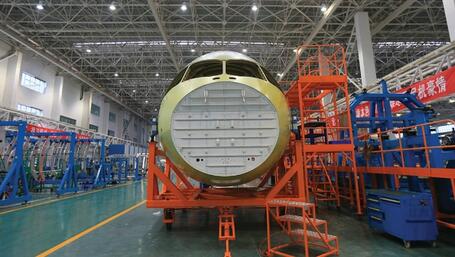
Two major sections of the first C919 fuselage have been connected, and the nose is in position to join them. “Final assembly is proceeding steadily,” says Comac, adding that it is trying to complete joining the structure by year-end, after which it will integrate the on-board systems. The roll-out is due in the third quarter of 2015.
Nov 03, 2014
This four-engine, medium/long-range, widebody commercial passenger and cargo transport aircraft first flew as the Il-96-300 in 1988 and was awarded certification in December 1992. It is powered by Aviadvigatel PS-90A1 engines rated 35,275 lb. thrust each. The Il-96-400, a stretched version of the -300, is powered by uprated PS-90A1 engines. The Il-96-400 passenger version can carry 436 passengers in a single-class configuration, 386 in two classes or 315 in a three-class layout. Two Il-96-300 are forecast for production in 2014-23.
Nov 03, 2014
The Irkut MS-21 is a twin-turbofan, narrowbody derivative of the defunct Yakovlev Yak-242 airliner. The MS-21 family is the 150-seat MS-21-200, 181-seat MS-21-300 and 212-seat MS-21-400. All three are to be available in both basic and extended-range versions; the -200 is also to be available in a long-range variant. Power will be provided by Pratt & Whitney PW1400G or Aviadvigatel PD-14 engines. First flight is planned for 2015, with a service entry target date of 2017. Primary competition for the MS-21 is likely to come from the Boeing 737, Airbus A320 and Comac C919.
Nov 03, 2014
Mitsubishi formally launched the twin-engine Mitsubishi Regional Jet (MRJ) family in March 2008; rollout was late last month. Initially, two basic models are planned: the 78-passenger MRJ70 and 92-passenger MRJ90. The MRJ70 is powered by 15,600-lb.-thrust Pratt & Whitney PW1215G engines, while the MRJ90 is powered by 17,600-lb.-thrust PW1217Gs. Extended- and long-range versions of each model are envisioned, while a 100-seater dubbed the MRJ100 is being considered. First flight is planned for the second quarter of 2015, with service entry slated for 2017.
Nov 03, 2014
This pressurized, single-turboprop-powered, corporate/utility transport aircraft first flew in May 1991, and received Swiss and U.S. certification in 1994. It has seating for nine passengers in its standard layout. Portugal’s OGMA assembles green aircraft and manufactures some components. The current PC-12 production version, the PC-12 NG (Next Generation), is powered by a 1,200-shp Pratt & Whitney Canada PT6A-67P turboprop engine. Some 1,231 PC-12s, including 443 PC-12 NGs, were built through 2013. Production of 846 units is expected in 2014-23.
Nov 03, 2014
Launched in 2007, RUAG Aerospace’s Do 228NG (Next Generation) is an updated version of Dornier’s original Do 228. The aircraft is powered by twin 776-shp Honeywell TPE331-10 engines, and features other improvements such as a new glass cockpit, five-blade propellers and aerodynamic changes to the wing. The first RUAG-produced Do 228NGs were delivered to customers in 2010, with eight aircraft delivered to date.
Nov 03, 2014
The Sukhoi Superjet 100 is a family of twin-engine regional transports powered by Snecma/NPO Saturn SaM146 turbofan engines, rated at 13,500-17,500 lb. thrust each. The series was launched with a 95-98-seat baseline model, the Superjet 100-95. The shortened 100-75, a 75-78-seat version, and the lengthened 100-115/120, a 115-120-seat version, are being considered. The Superjet 100-95 made its first flight in May 2008, and achieved initial Russian/Commonwealth of Independent States certification in early 2011.