
Latest Commercial Aviation Content by Aviation Week & Space Technology
May 07, 2012
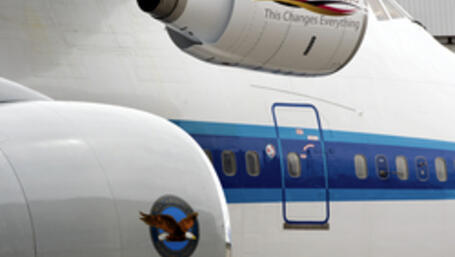
The mounting tempo of new commercial airliner development programs has heaped unprecedented pressure on engine makers to bolster test capabilities and, in particular, to modernize their flying testbeds.

May 07, 2012
Earlier this year, in advance of Chinese Vice President Xi Jinping's visit to Los Angeles, U.S. Commerce Secretary John Bryson convened a luncheon meeting of 20 or so Southern California business leaders. He touted U.S. exports to China, which last year exceeded $100 billion for the first time. I pointed out to him that spending by Chinese visitors, which is counted as a U.S. export, was $5 billion in 2010. In other words, tourist dollars alone account for 5% of U.S. exports to China.
May 07, 2012
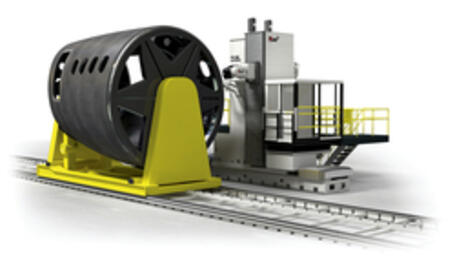
Automotive-style robots are moving onto the aircraft assembly line to save time and cost. Bombardier plans to use six single-arm robots to join the cockpit and fuselage sections of its CSeries airliner, saving more than 40 hr. Each 12-ton robot will be able to drill a hole and insert a fastener in 32 sec. for aluminum-lithium structures and 53 sec. for composites.
May 07, 2012
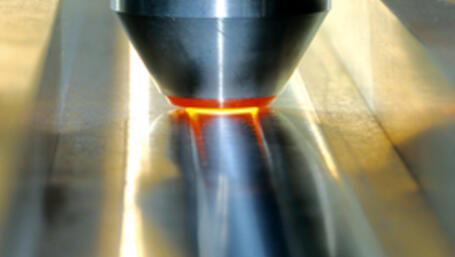
Friction welding fuses metals without melting them and is used in aerospace to join engine disks (rotational welding) or fabricate aircraft and spacecraft structures (friction-stir welding). Now hybrid components produced by linear friction welding of dissimilar metals promise to overcome a key disadvantage of composites: carbon fiber cannot be attached directly to aluminum because of galvanic corrosion, forcing use of higher-cost titanium. But friction welding can allow titanium to be incorporated into the join between aluminum and composite structures.
May 07, 2012
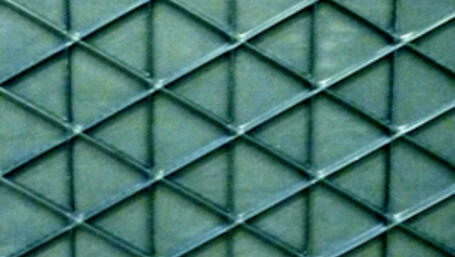
Isogrids are among the lightest and strongest of structures, the lattice pattern of integral stiffening ribs providing extremely high strength-to-weight ratios. Lightweight isogrid panels machined from aluminum plate to produce thin-walled, self-stiffened and damage-tolerant structures are used in launch vehicles and aircraft doors. Advanced grid structures made from composites have been used for components such as payload shrouds, but require time-consuming and costly manual layup. Isogrid Composites Canada Inc.
May 07, 2012
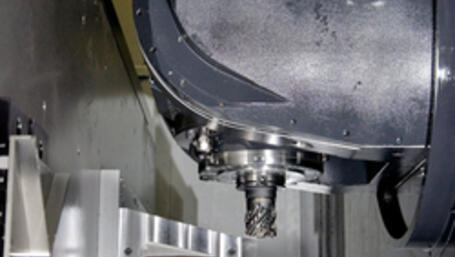
Composites may be replacing metals in aircraft structures, but the use of titanium is increasing both to reduce weight and because of the incompatibility of aluminum and carbon fiber. Boeing's 787 is 50% composite by structural weight, whereas its earlier 777 is only 12%, but a 787 contains almost 90 tons of titanium compared with 55 tons in a larger 777. And titanium can be around 10 times as expensive as aluminum, so pressure is on to reduce costs.
May 07, 2012
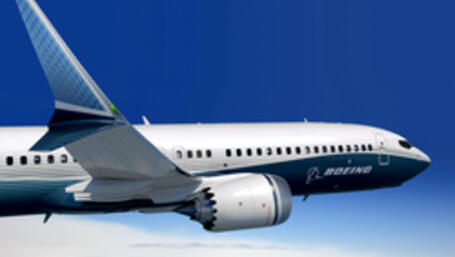
With ground to make up in the marketing battle with Airbus and the A320NEO, Boeing is going to new lengths to eke out improved aerodynamic efficiency on the competing 737 MAX.

May 07, 2012
As a former Darpa scientist and one of the world's foremost authorities on materials, Leo Christodoulou is accustomed to thinking out of the proverbial box when it comes to problem-solving. At the Defense Advanced Research Projects Agency, he applied his research expertise to developing revolutionary, new materials for the U.S. military.