
‘Stewardesses’ Clamor For Rights (1967)
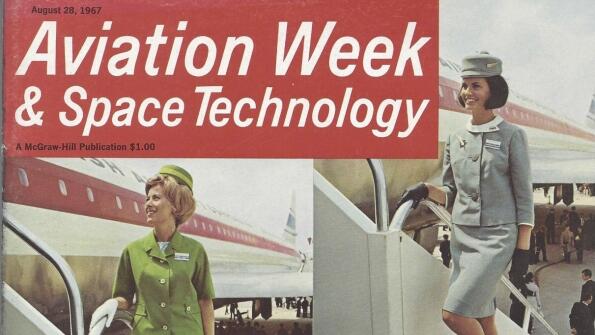
It’s tempting to call the 1960s the “Golden Age of Aviation,” when passengers dressed up to board the new “jetliners” flown by storied airlines like Pan Am and TWA, and flying was an event. Part of that event—and much of the glamour—came from the service onboard, provided by beautiful and elegant stewardesses, as flight attendants were then known, ever ready to refresh a drink or light a passenger’s cigarette.
But beyond the stewardesses’ Balmain-, Pucci-, and Pierre Cardin-designed uniforms lay an ugly reality of mandatory weigh-ins, girdle-checks and early retirement ages. On that front, Aviation Week and Space Technology in a 1967 issue quotes an unnamed airline executive defending a retirement age in the early 30s: “Women are subject to changes in metabolism and in the endocrine, circulatory, digestive and cutaneous systems, symptoms of which would interfere with the desirable performance of the job.”

The article, which refers to stewardesses as “girls” throughout, is about new uniforms U.S. airlines were planning in 1967 and featured an aside on stewardesses challenging mandatory retirement ages, something that seemed to take our reporter by surprise. “Passenger preference—or at least masculine passenger preference—for young and pretty girls as stewardesses is a point that is difficult to raise safely at the bargaining table with hostesses.”
I'm sure it was.
Five years later, Aviation Week reported on radical cabin innovation some U.S. carriers were trying: male stewards. But even this was not about equality. In the 1972 article, we report that male flight attendants were not expected to replace women in the foreseeable future, “although men may be more physically qualified to handle the workload produced by the wide-body jets.”
There’s no way to sugarcoat any of this. It’s vile and worth remembering whenever we’re tempted to wax nostalgic for those days. But in the intervening decades, flight attendants in the U.S. and Europe have won many battles, consigning weigh-ins, girdle checks, mandatory retirement ages and even smoking onboard to the dustbin of history, where such practices belong.
But even now time occasionally wrinkles and the debate begins anew. The rise of the three Persian Gulf carriers, Emirates, Etihad and Qatar, has caused some to question their hiring practices. Labor groups in both Europe and the U.S. have suggested the three Gulf carriers have resurrected employment practices that long ago were banned in the West. The Gulf carriers deny much of what is leveled at them, but the questions remain.
Read the August 28, 1967 article: Stewardesses Seek Change In Airline Role
► Aviation Week is approaching its 100th anniversary in 2016. In a series of blogs, our editors highlight editorial content from the magazine's long and rich history, including viewpoints from the industry's most iconic names and stories that have helped change the shape of the industry.