Investigators Urge DGAC To Add Controllers At French Caribbean Airport
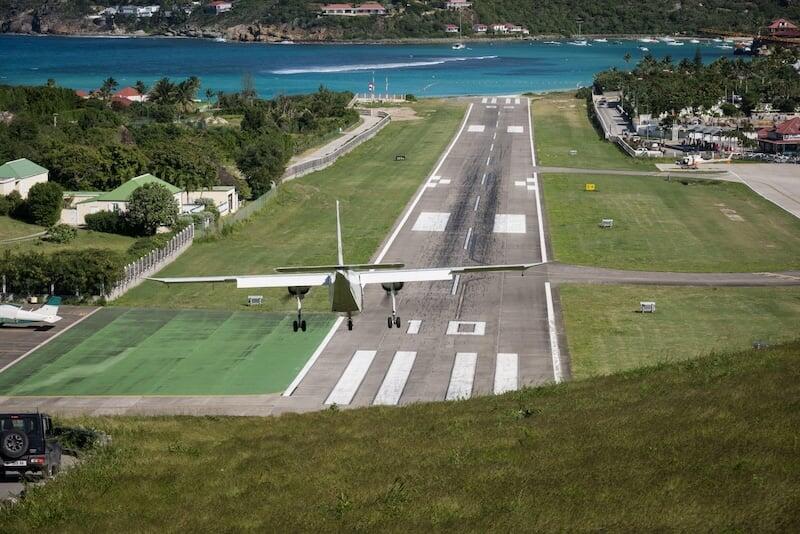
Aircraft landing on the runway at Rémy de Haenen Airport on Saint-Barthélémy.
The French air accident investigation agency BEA is urging France's civil aviation authority, the DGAC, to establish proper air traffic control at Saint-Barthélémy airport in the Caribbean following a near miss on Dec. 28, 2024.
Instead of air traffic controllers, whose role includes giving instructions and clearances to crews, the busy Saint-Barthélémy airport—a luxury destination on the eponymous island—has Aerodrome Flight Information Service (AFIS) agents, who only share information.
In daytime on Dec. 28, 2024, a St Barth Executive-operated Pilatus PC-12 turboprop caught up with a slower SXM Airways-operated Britten-Norman BN2, eventually coming within 100 ft. above, the final report says.
The serious incident took place as significant safety events have recurred at Saint-Barthélémy since 2023, including inflight near misses, runway incursions and landings on a busy runway, the BEA emphasizes.
The airport’s operational environment is both complex and restrictive. The absence of procedures for operations under instrument flight rules (IFR); terrain in the vicinity; a short runway; prohibited takeoff and go-around on Runway 28; a last turn in short final to Runway 28; a nonstandard traffic pattern; a steep approach; and dense traffic combine to create challenging conditions.
Pilots in both aircraft on Dec. 28, 2024, had an erroneous situational awareness, as they both thought they were alone in the traffic pattern, the BEA says.
The PC-12’s pilot spoke with the AFIS agent in French, a language the BN2’s crew did not understand. The PC-12’s pilot, however, spoke both languages and could have realized another aircraft was flying nearby.
In addition, the BN2 was not equipped with a traffic collision avoidance system (TCAS), but the PC-12 was equipped. However, the BN2’s transponder was either off or faulty, meaning the PC-12’s TCAS did not receive a signal that would have prompted an alert.
Both aircraft had taken off from Princess Juliana Airport, on the Dutch island of Saint-Martin, just 17 nm away.
Neither the air traffic controller at Princess Juliana Airport nor the AFIS agent at Saint-Barthélémy gave traffic information to the PC-12 or the BN2 crews, the investigators point out.
The AFIS agent said he was busy with ground traffic and did not look at the display that gathers radar and Automatic Dependent Surveillance-Broadcast (ADS-B) information.
The “see and avoid” principle for collision prevention proved fragile in Saint-Barthélémy’s environment, the BEA added. The airspace is small and has an unusual layout. Traffic is dense, aircraft have heterogeneous speeds and flightpaths often converge.
Since the incident, the DGAC has experimented with a flight schedule coordination arrangement at Saint-Barthélémy. Carriers received arrival slots corresponding to the availability of parking spaces on the apron, thus limiting airspace congestion.
A notification was issued to pilots to curb the risk of runway incursions, asking them to wait at holding points until they receive traffic information from AFIS.
Controllers are allowed to share traffic information solely based on communications. They may use the radar/ADS-B display for assistance only, as that tool is not certified due to limited accuracy.
The AFIS operator has requested an exemption to use it to provide flight information service, and the DGAC aims to grant the exemption late in 2026, the BEA says.
St Barth Executive now allows only English for radio communications at Saint-Barthélémy. Crews should exchange more on the radio for safe passings and before takeoff.
Princess Juliana Airport will mandate transponders in the terminal control area, which includes Saint-Barthélémy.
The BEA recommends that the DGAC create an air traffic control service at Saint-Barthélémy. The DGAC should also implement risk mitigation measures, such as the operational use of the radar/ADS-B display, the investigators say.
Cooperation with Saint-Martin’s civil aviation authorities should strengthen and rely on an airspace redesign, BEA adds.

Related Content