
Finding Our Own History In 100-Year Archive
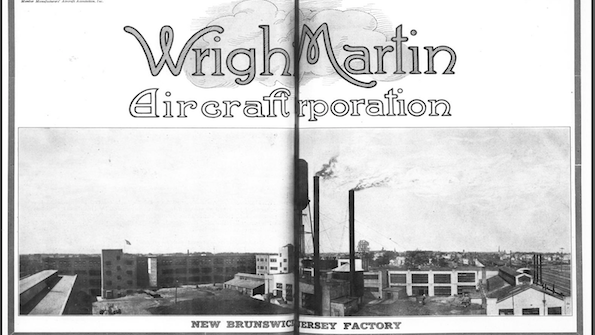
Serendipity can lead you to amazing discoveries in Aviation Week's 100-Year Archive. One of our interns who was checking the 400,000 pages scanned into the archive asked me a question about an ad for the Wright-Martin Aircraft Corp. in an issue from 1917.

The two-page spread ad featured a photo of Wright-Martin's New Brunswick, N.J., aircraft factory. For nearly eight years in the 1990s, I'd lived in that city, home to Rutgers University and Johnson & Johnson.
I could tell the approximate location from the Northeast Corridor railroad tracks in the lower right corner of the photo (above). But until that day, I'd never had a hint that the facility turned out military aircraft engines during World War I.
The buildings looked familiar, but the old city has many factory buildings with a similar appearance.
A call to the New Brunswick Free Public Library helped fill in the holes. After the war ended, government aircraft orders to Wright-Martin fell sharply, and the company could no longer justify the cavernous factory on Jersey Avenue. By 1922, International Motors had taken over the facility. Later, Simplex Automobiles and Mack Trucks occupied the facility, library director Bob Belvin said in an email.
It turns out that I’d lived less than two miles from the old factory and driven by it many times.
Searching our 100-Year Archive, an article about the merger of the Wright Co. and the Glenn L. Martin Co. had more details about the factory, which had a “technical laboratory” for testing metals used in aero and automotive engines.
Wright-Martin had a contract to build 450 150-hp., V8, liquid-cooled engines from a licensed Hispano-Suiza design at the plant. The engine was used in an airplane designed by Chauncey Vought for use by the allies.
New Brunswick had other aviation ties. The nearby Lincoln Gardens neighborhood has a number of streets named for early aviators, including Wright Place, Mitchell Avenue and Curtis Place, Belvin wrote. Workers at the factory almost certainly lived in some of those homes, only a few blocks away. In fact, a friend of mine lives on Lufberry Place, named for the French World War I ace who conceived the Lufberry Circle maneuver.
The old factory buildings still stand along Jersey Avenue and are now home to a technology innovation center, so in a way they're still filling the role they did nearly a century ago, advancing technical knowledge and driving economic growth.